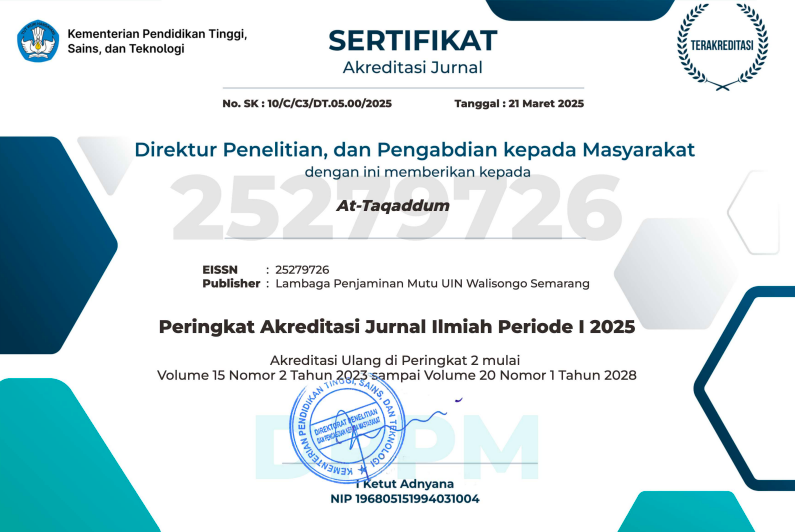
Accredited by
KEMENDIKBUD based on
Decree of Directorate General of Higher Education, No. SK: 10/C/C3/DT.05.00/2025
on "2nd Level"

At-Taqaddum permits the use of Generative Artificial Intelligence (AI) and AI-assisted technologies only as a supporting tool, never as a substitute for human scholarship, and requires every such use to be disclosed. This policy applies to authors, reviewers, editors, and the publisher, the Institute for Quality Assurance (Lembaga Penjaminan Mutu/LPM), Universitas Islam Negeri Walisongo Semarang.
As a journal devoted to quality assurance, governance, and organizational quality in educational institutions, At-Taqaddum holds its own publication process to the same standard of quality it studies. Responsible AI use can improve language, efficiency, and scholarly communication. Undisclosed or inappropriate use, however, threatens originality, the validity of evidence, and academic accountability.
This policy follows the guidance of the Committee on Publication Ethics (COPE) and the values of Islamic scholarly ethics, namely amanah (trustworthiness), ṣidq (truthfulness), ‘adl (fairness), and itqān (excellence and meticulousness in work). All manuscripts published in At-Taqaddum must fundamentally reflect human intellectual contribution and scholarly judgment. The policy will be reviewed periodically as technologies and publishing practices evolve.
At-Taqaddum adopts six principles that govern every use of AI in its publication process.
Authors may use AI only for supportive, non-substantive tasks, and must disclose every use beyond basic proofreading.
Research on quality assurance often involves accreditation evidence, internal audit reports, institutional performance data, and responses from students, lecturers, staff, alumni, or graduate users. Authors must not upload such material into AI tools that store, share, or train on user input unless it has been fully anonymized and the authors hold permission from the data owner. Authors remain responsible for protecting research participants and institutions in line with research ethics approval and Law No. 27 of 2022 on Personal Data Protection.
In line with the COPE position statement on authorship and AI tools, authors must disclose any substantive use of AI at the time of submission, naming the tool, its version, and how it was used.
“During the preparation of this manuscript, the authors used [AI tool name, version] for [specific purpose, e.g., language editing of the discussion section or translation from Indonesian]. The authors reviewed and verified all output and take full responsibility for the content of the publication.”
Basic proofreading with grammar or spelling checkers does not require disclosure. Disclosure exists to make the work transparent, not to penalize authors, so honest disclosure of permitted use will not count against a manuscript. Undisclosed AI use discovered during review or after publication is treated as misrepresentation under COPE guidance.
All authors remain fully accountable for:
In line with the COPE position statement on authorship and AI tools, AI tools and large language models cannot be listed as authors or co-authors, because they:
Reviewers may use AI only to polish their own writing, and must never place any part of a manuscript into an AI tool.
Reviewers who use AI to refine the language of their report must state this briefly in their confidential comments to the editor, naming the tool and its purpose.
Reviewers must:
Editors may use AI only for administrative, non-decisional tasks under human oversight; every editorial decision remains a human decision.
Editors are responsible for:
LPM UIN Walisongo Semarang, as publisher of At-Taqaddum, may use AI tools to optimize editorial workflows, such as plagiarism checks, metadata organization, and indexing support, on three conditions:
At-Taqaddum upholds ethical AI use consistent with COPE and Islamic ethics, emphasizing truthfulness (ṣidq) and accountability (mas’ūliyyah) in research, transparency in declaring AI use, and the protection of data privacy and intellectual property throughout the publication process.
Suspected violations are handled according to COPE flowcharts and the COPE retraction guidelines revised in 2025, which list undisclosed involvement of AI as a form of misrepresentation that warrants retraction. Those involved are given the opportunity to respond, and the journal may publish an expression of concern while a case is under investigation. Confirmed non-compliance may result in:
The table below summarizes, section by section, which AI uses are permitted; where it and the text above differ, the text above prevails.
|
Section |
AI Usage Area |
Example |
Permitted? |
|---|---|---|---|
|
Abstract |
Abstract creation |
Using AI to generate or expand the abstract from prompts or prior text |
No |
|
Abstract |
Abstract copy-editing |
Correcting grammar and clarity of the author’s own abstract |
Yes |
|
Introduction |
Ideation |
Exploring general ideas, background topics, or research directions, as with a search engine |
Yes |
|
Introduction |
Introduction creation |
Drafting or expanding the introduction with AI prompts |
No |
|
Introduction |
Introduction copy-editing |
Improving readability and grammar without altering meaning |
Yes |
|
Literature review |
Literature discovery |
Finding literature or identifying research gaps; every source verified by the author |
Yes |
|
Literature review |
Literature review creation |
Writing or summarizing prior research with AI |
No |
|
Literature review |
Literature review copy-editing |
Editing the language or format of the author’s own review |
Yes |
|
Methods |
Methodology ideation |
Exploring possible quality-assurance models, frameworks, or instruments for consideration |
Yes |
|
Methods |
Methodology creation |
Writing or generating the methods section with AI |
No |
|
Methods |
Methodology copy-editing |
Refining the author’s existing methods text for clarity and grammar |
Yes |
|
Data |
Interview transcription |
Transcribing recordings with participant consent and no exposure of identifying data; checked by the author |
Yes (declare) |
|
Data |
Uploading confidential data |
Placing identifiable survey responses, audit reports, or accreditation evidence into public AI tools |
No |
|
Results |
Data generation |
Creating, simulating, or completing data, responses, or statistical outputs |
No |
|
Results |
Qualitative coding and interpretation |
Having AI code interview data or interpret findings |
No |
|
Results |
Data visualization |
Making graphs or charts from verified, existing data that reflect results accurately |
Yes (declare) |
|
Results |
Results copy-editing |
Shortening or reformatting the author’s own written results for readability |
Yes |
|
Discussion |
Discussion creation |
Generating or expanding analytical or interpretive content |
No |
|
Discussion |
Discussion copy-editing |
Refining grammar, flow, or readability while preserving meaning |
Yes |
|
Conclusion |
Conclusion creation |
Generating or expanding the conclusion with AI prompts |
No |
|
Conclusion |
Conclusion copy-editing |
Editing the author’s conclusion for readability and clarity |
Yes |
|
Additional |
Translation |
Translating the author’s original, unpublished work, verified by the author |
Yes (declare) |
|
Additional |
References and citations |
Generating or automatically compiling reference lists or citations with AI |
No |
|
Additional |
Acknowledgments and declarations |
Polishing or formatting author-written statements |
Yes |
|
Code |
Code generation |
Writing new analytical or statistical code with AI prompts |
No |
|
Code |
Code editing |
Improving readability of, or commenting on, existing human-written code |
Yes |
|
Images and visuals |
Conceptual diagrams |
Creating process or conceptual diagrams, labeled “AI-generated” and checked for accuracy |
Yes (declare) |
|
Images and visuals |
Factual or evidential images |
Generating or altering photographs, system screenshots, or scanned documents used as evidence |
No |
|
Images and visuals |
Artistic renderings |
Producing decorative cover art or graphical abstracts with AI |
No |
|
Peer review |
Review copy-editing |
Reviewer refines the language of their own report, with disclosure to the editor |
Yes (declare) |
|
Peer review |
Review content generation |
Reviewer uses AI to evaluate, summarize, or judge a manuscript |
No |
|
Editorial |
Workflow tools |
Plagiarism checks, reviewer matching, or workflow management under human oversight |
Yes |
|
Editorial |
Decision-making |
Using AI to recommend acceptance or rejection |
No |
Accredited by
KEMENDIKBUD based on
Decree of Directorate General of Higher Education, No. SK: 10/C/C3/DT.05.00/2025
on "2nd Level"