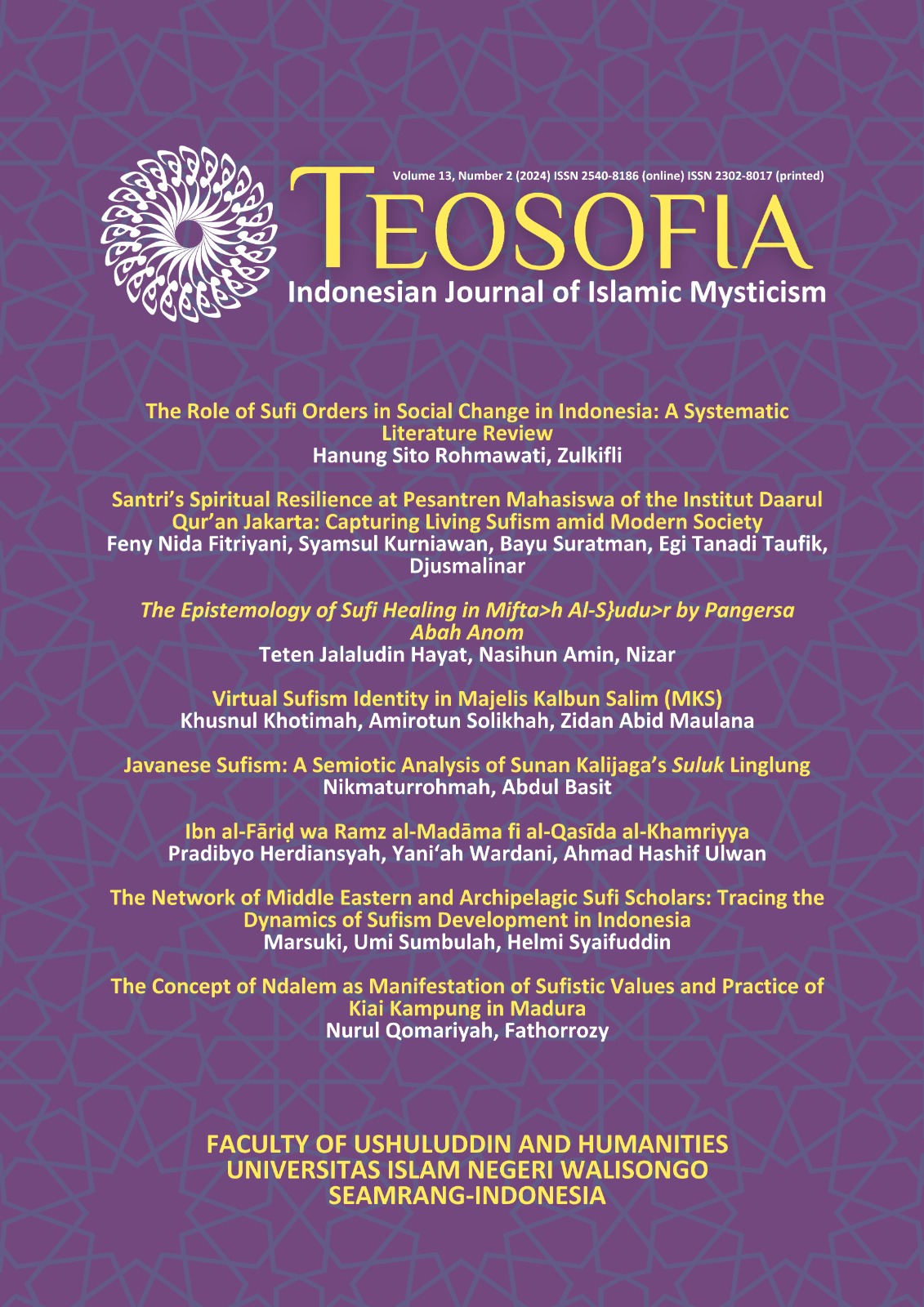
The Epistemology of Sufi Healing in Miftāḥ al-Ṣudūr by Pangersa Abah Anom
DOI:
https://doi.org/10.21580/tos.v13i2.21941Keywords:
Epistemology, Sufi Healing, Dhikr, Miftāḥ al-Ṣudūr, mental impuritiesAbstract
The global rise of mental health issues has encouraged the search for therapeutic models that integrate spiritual and psychological dimensions. Sufism provides a rich foundation for inner healing, yet its epistemological basis is still underexplored. This study examines the epistemology of Sufi healing in Miftāḥ al-Ṣudūr [The Key of Hearts] by Pangersa Abah Anom, employing a descriptive qualitative method and the Miles and Huberman analysis model. Classical Sufi concepts like purification, emptying, and filtering of the self, combined with psychological and neuroscientific insights, form a holistic framework for self-healing. Dhikr and spiritual heart-to-heart transmission are mechanisms for inner purification, emotional regulation, and neuroplasticity. Sufi healing presents an interdisciplinary paradigm relevant to the mental health discourse; however, it is limited to textual analysis and lacks empirical field data. Future studies should incorporate ethnographic and clinical approaches involving active Sufi practitioners.
Contribution: This study establishes an epistemological framework for Sufi healing by integrating classical Sufi concepts with psychological and neuroscientific insights. It introduces a new perspective on healing through epistemological awareness of mental impurity and mind-wandering.
Downloads
References
’Arifin, Ahmad Shohibulwafa Tajul. Mifta>h Al-S}udu>r. Tasikmalaya: IAI-Latifah Mubarokiyah Pondok Pesantren Suryalaya, 1990.
Abou El Fadl, Khaled. “The Epistemology of the Truth in Modern Islam.” Philosophy & Social Criticism 41, no. 4–5 (2015): 473–86. https://doi.org/10.1177/0191453715577739.
Al-Daghistani, Raid. “Sufis.” In Routledge Handbook of Islamic Ritual and Practice. Routledge, 2022. https://doi.org/10.4324/9781003044659-15.
Al-Ghazālī, Abū Ḥāmid Muhammad. Al-Awfāq. Maktabah Ashā’at al-Islām, n.d.
———. Al-Munqidh Min Al-Ḍalāl. Beirut: Dār al-Kutub al-ꜤIlmīya, 1988.
———. Iḥyā’ ‘Ulūm Al-Dīn. Cairo: Dār Ibn Ḥazm, 2005.
———. Minhāj Al-ꜤĀbidīn. Beirut: Dār al-Minhāj, 2006.
———. Mukāshafa Al-Qulūb. Cairo: Maktaba Muṣṭafā al-Bāb al-Jīlī, 1952.
Al-Jīlānī, ’Abd al-Qādir. Al-Fatḥ Al-Rabbānī Wa Al-Fayḍ Al-Raḥmānī. Cairo: Dār al-Rayyān al-Turāth, n.d.
———. Al-Gunyah Li-Ṭālibī Ṭarīq Al-Ḥaqq. Beirut: Dār al-Turāth al-‘Arabī, 1996.
———. Sirr Al-Asrār Fīmā Yaḥtāju Ilayhi Al-Abrār. Cairo: Maṭba’ah al-Bāhīya, n.d.
———. Tafsīr Al-Jīlānī. Vol. 3. Maktaba MaꜤrūfīya, 2010.
Al-Kurdī, Muḥammad Amīn. Tanwīr Al-Qulūb Fī Mu‘āmala ‘Allām Al-Ghuyūb. Cairo: Makātib Shahīra, n.d.
Al-Malṭāwī, Ḥasan Kāmil. Al-Ṣūfīya Fī Ilhāmihim. Cairo: Wizārat al-Awqāf al-Majlis al-A’lā li al-ShuꜤūn al-Islāmīya, 1999.
Al-NuꜤmānī, Abu Hafṣ Sirāj al-Dīn. Al-Lubāb Fī ꜤUlūm Al-Kitāb. Vol. 9. Beirut: Dār al-Kutub al-ꜤIlmīya, 1998.
Al-Qādirī, IsmāꜤīl Muḥammad. Al-Fuyūḍat Al-Rabbānīya. Cairo: Maktaba Muṣṭafā al-Bāb al-Jīlī, n.d.
Al-Sha’ānī, Abdul Wahab. Lawāqiḥ Al-Anwār Al-Qudsīya Fi Bayān Al-’Uhūd Al Muḥammadīya. Aleppo: Dār al-Qalam al-ꜤArabī, 1993.
Alyahya, Norah M, and Shahad Alanazi. “Spiritual Care for Clients with Mental Illness from an Islamic Background: Nursing Students’ Perspectives.” Journal of Psychiatric and Mental Health Nursing 31, no. 6 (2024): 998–1006. https://doi.org/10.1111/jpm.13054.
Arifin, Ahmad Shohibulwafa Tajul. Akhlaqul Karimah Akhlaqul Mahmudah Berdasarkan Mudawamatu Dzikrillah. Tasikmalaya: YSB Ponpes Suryalaya, 2015.
———. Kitab Uquudul Jumaan: Dhikr Harian, Khotaman, Wiridan, Tawassul, Silsilah. Tasikmalaya: PT. Mudawwamah Warrohmah, 2022.
Arifin, Samsul, Mokhammad Baharun, and Miftahul Alimin. “Psycho-Sufistic Counseling to Develop Students’ Sociocultural Literacy BT -.” In Proceedings of the International Conference on Madrasah Reform 2021 (ICMR 2021), 300–307. Atlantis Press, 2022. https://doi.org/10.2991/assehr.k.220104.045.
Asiyah, Siti, and Achmad Lutfi. “Strategy and Effectivity of Sufi Healing as a Therapeutic Process for Curing Diseases.” Teosofia: Indonesian Journal of Islamic Mysticism 12, no. 2 (2023): 279–302. https://doi.org/10.21580/tos.v12i2.18917.
Azram, M. “Epistemology -An Islamic Perspective.” IIUM Engineering Journal 12, no. 5 (2012): 179–87. https://doi.org/10.31436/iiumej.v12i5.240.
Bogdan, Robert C., and Sari Knopp Biklen. Qualitative Research for Education: An Introduction to Theory and Methods. 3rd ed. Boston: Allyn and Bacon, 1998.
Calderone, Andrea, Desirée Latella, Federica Impellizzeri, Paolo de Pasquale, Fausto Famà, Angelo Quartarone, and Rocco Salvatore Calabrò. “Neurobiological Changes Induced by Mindfulness and Meditation: A Systematic Review.” Biomedicines 12, no. 11 (2024): 2613. https://doi.org/10.3390/biomedicines12112613.
Elendu, Chukwuka. “The Evolution of Ancient Healing Practices: From Shamanism to Hippocratic Medicine: A Review.” Medicine 103, no. 28 (2024): e39005. https://doi.org/10.1097/MD.0000000000039005.
Field, Thomas A., Daria B. White, Jama Davis, Jennifer S. Park, and Jerry L. Pierson. “Scoping Review of Spirituality-Integrated Psychotherapies for Posttraumatic Stress Disorder.” Spirituality in Clinical Practice 11, no. 3 (2023): 203–221. https://doi.org/10.1037/scp0000335.
Futūḥī, Taqī al-Dīn Muḥammad. Sharḥ Al-Kawkab Al-Munīr. 3rd ed. Vol. 3. Maktaba al-’Abikan, 1997.
Ifrīqī, Muḥammad ibn Manṣūr. Lisān Al-ꜤArab. Vol. 6. Beirut: Dar al-Ṣādir, 1993.
Iqbal, Tahmina, and Mazhar Farid. “Sufi Practices as the Cause of Spiritual, Mental and Physical Healing at Chishti Shrines in Pakistan.” Mental Health, Religion & Culture 20, no. 10 (2017): 943–53. https://doi.org/10.1080/13674676.2017.1372736.
Islamy, Mohammad Rindu Fajar, Yedi Purwanto, Usup Romli, and Alwan Husni Ramdani. “Spiritual Healing: A Study of Modern Sufi Reflexology Therapy in Indonesia.” Teosofi: Jurnal Tasawuf Dan Pemikiran Islam 12, no. 2 (2022): 209–31. https://doi.org/10.15642/teosofi.2022.12.2.209-231.
Kamaludin, Ihsan, and Maya Najihatul Ula. “Sufism Healing Method for Drugs Rehabilitation: A Case Study in PP. Suryalaya Tasikmalaya, West Java, Indonesia.” Ulumuna 23, no. 2 (2020): 384–401. https://doi.org/10.20414/ujis.v23i2.351.
Kamshakhānawī, Aḥmad Musṭafā. JāmiꜤ Al-Uṣūl Fī Al-Awliyā’. Surabaya: Maṭba‘a al-Ḥaramayn, n.d.
Kodir, Muhamad. Jejak Abah Anom Di Asia Tenggara: Dari Suryalaya Untuk Dunia. Edited by Try Riduwan Santoso. Tasikmalaya: CV. Putra Surya Sentosa, 2023.
Latif, Juraida, Shaakirah Dockrat-Boda, and G. Hussein Rassool. Integrating Spiritual Interventions in Islamic Psychology: A Practical Guide. Milton Park: Routledge, 2004. https://doi.org/10.4324/9781003344827.
Lorea, Carola E., Neena Mahadev, Natalie Lang, and Ningning Chen. “Religion and the COVID-19 Pandemic: Mediating Presence and Distance.” Religion 52, no. 2 (2022): 177–198. https://doi.org/10.1080/0048721X.2022.2061701.
Malik, Adam, and Ahmad Barizi. “The Islamic Perspective on Trilogy Epistemology: Bayāni, Burhāni, and ‘Irfāni.” TAJDID 29, no. 1 (2022): 83–104. https://doi.org/10.36667/tajdid.v29i1.857.
Mitha, Karim. “Sufism and Healing.” Journal of Spirituality in Mental Health 21, no. 3 (2019): 194–205. https://doi.org/10.1080/19349637.2018.1464423.
Muaz, Abdul, and Adang Darmawan Ahmad. “Psycho-Sufistic Therapy of Underground Sufism Movement: A Healing Method Against Punk Community in Jakarta.” Teosofia: Indonesian Journal of Islamic Mysticism 8, no. 2 (2019): 131–44. https://doi.org/10.21580/tos.v8i2.5302.
Mulyati, Sri. Peran Edukasi Tarekat Qadiriyyah Naqsyabandiyyah Dengan Referensi Utama Suryalaya. Jakarta: Kencana, 2010.
Mulyati, Sri, and Zahrotun Nihayah. “Sufi Healing in Indonesia and Malaysia: An Updated Study of Rehabilitation Methods Practiced by Qadiriyya Naqshbandiyya Sufi Order.” ESOTERIK 6, no. 1 (2020): 1–32. https://doi.org/10.21043/esoterik.v6i1.7085.
Nāzilī, Muḥammad Ḥaqqī. Khazīnat Al-Asrār. Beirut: Dār al-Kutub al-ꜤIlmīya, 1993.
Nizamie, S Haque, Mohammad Zia Ul Haq Katshu, and N A Uvais. “Sufism and Mental Health.” Indian Journal of Psychiatry 55, no. 2 (2013): S215-23. https://doi.org/10.4103/0019-5545.105535.
Nuraeni, Aan, Suryani Suryani, Yanny Trisyani, and Anastasia Anna. “Islamic Spiritual Care, Depression, and Quality of Life Among Patients With Heart Disease: A Systematic Review.” Journal of Holistic Nursing : Official Journal of the American Holistic Nurses’ Association 42, no. 2 (2024): S7–25. https://doi.org/10.1177/08980101231180514.
Pambuka, Fian Rizkyan Surya, and Ahmad Saifuddin. “Whirling Dance as a Sufi Healing Method: A Phenomenological Study of the Sufi Dance Community in Surakarta.” Teosofi: Jurnal Tasawuf Dan Pemikiran Islam 13, no. 2 (2023): 204–31. https://doi.org/10.15642/teosofi.2023.13.2.204-231.
Rachmawanti, Ranti, and Djarlis Gunawan. “Implementation of Cultural Products in Medical Practices at Pesantren Suryalaya – Tasikmalaya.” Cogent Arts & Humanities 10, no. 2 (2023): 2268389. https://doi.org/10.1080/23311983.2023.2268389.
Rajab, Khairunnas. “Methodology of Islamic Psychotheraphy in Islamic Boarding School Suryalaya Tasik Malaya.” Indonesian Journal of Islam and Muslim Societies 4, no. 2 (2014): 257–89. https://doi.org/10.18326/ijims.v4i2.257-289.
Rakhmat, Mamat. Tanbih Dari Masa Ke Masa. Tasikmalaya: Yayasan Serba Bakti Pondok Pesantren Suryalaya, 2005.
Rassool, G Hussein, and Wajeeha Nisar Ahmed Khan. “Hope in Islāmic Psychotherapy.” Journal of Spirituality in Mental Health 26, no. 3 (2024): 234–48. https://doi.org/10.1080/19349637.2023.2207751.
Rijal, Syamsul, and Rasyidin Muhammad. “’Irfani Epistemology in Islamic Philosophy Perspective.” Journal Analytica Islamica 10, no. 1 (2021): 25–38. https://doi.org/10.30829/jai.v10i1.11353.
Salahudin, Asep. Pangersa Abah Anom Wali Fenomenal Abad 21 Dan Ajarannya. Jakarta: Noura Books, 2013.
Sari, Maula, and Marhaban. “The Self Purification Through Dhikr in the Perspective of Imam Al-Ghazali.” Tasfiyah: Jurnal Pemikiran Islam 7, no. 2 (2023): 339–359. https://doi.org/10.21111/tasfiyah.v7i2.10581.
Syukur, Muhammad Amin. “Sufi Healing: Terapi Dalam Literatur Tasawuf.” Walisongo Jurnal Penelitian Sosial Keagamaan 20, no. 2 (2012): 391–412. https://doi.org/10.21580/ws.20.2.205.
Tang, Yi-Yuan, and Leslie D Leve. “A Translational Neuroscience Perspective on Mindfulness Meditation as a Prevention Strategy.” Translational Behavioral Medicine 6, no. 1 (2016): 63–72. https://doi.org/10.1007/s13142-015-0360-x.
Tim Penyusun. Kumpulan Kuliah Subuh Sesepuh Pondok Pesantren Suryalaya. Tasikmalaya: Ponpes Suryalaya dan PT. Murawwamah Warohmah, 2012.
Yulianto, Eko, Wahyudin, Sufyani Prabawanto, and Ahmad Tafsir. “Some Ethnomathematics Interpretations about the Practice of Dhikr Jahar of Tariqa Qodiriyah Naqsyabandiyah Ma’had Suryalaya.” Journal of Physics: Conference Series 1477, no. 4 (2020): 042032. https://doi.org/10.1088/1742-6596/1477/4/042032.
Zoellner, Lori A, Norah C Feeny, Dega A Angula, Mohamed H Aideed, Essa N Liban, Muumin H Egeh, Abdisalan I Awke, et al. “Islamic Trauma Healing (ITH): A Scalable, Community-Based Program for Trauma: Cluster Randomized Control Trial Design and Method.” Contemporary Clinical Trials Communications 37 (2024): 101237. https://doi.org/10.1016/j.conctc.2023.101237.
Downloads
Published
How to Cite
Issue
Section
License
Copyright (c) 2024 Teosofia: Indonesian Journal of Islamic Mysticism

This work is licensed under a Creative Commons Attribution-ShareAlike 4.0 International License.
Copyright
The copyright of the received article shall be assigned to the journal as the publisher of the journal. The intended copyright includes the right to publish the article in various forms (including reprints). The journal maintains the publishing rights to the published articles. Therefore, the author must submit a statement of the Copyright Transfer Agreement.*)
Licensing

This work is licensed under a Creative Commons Attribution-ShareAlike 4.0 International License.
In line with the license, authors are allowed to share and adapt the material. In addition, the material must be given appropriate credit, provided with a link to the license, and indicated if changes were made. If authors remix, transform or build upon the material, authors must distribute their contributions under the same license as the original.
_______
*) Authors whose articles are accepted for publication will receive confirmation via email and send a Copyright Transfer Agreement.