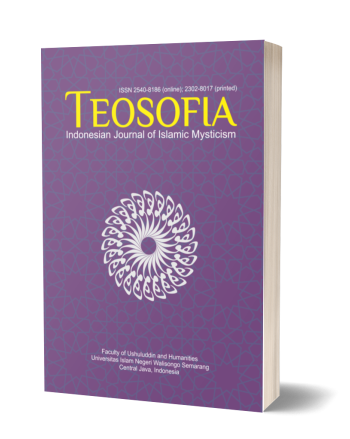


About the Journal

Journal Title Teosofia: Indonesian Journal of Islamic Mysticism
Abbreviation Teosof. Indones. J. Islam. Mysticism
Short Title Teosofia
Language English (preferred); Arabic
ISSN 2540-8186 (online); 2302-8017 (printed)
Editor in Chief Prof. Dr. Hasyim Muhammad, M.Ag. (Scopus; Orcid; Google Scholar)
Co-Editor in Chief Muhammad Faiq, M.A. (Scopus; Orcid; Google Scholar)
Publisher Faculty of Ushuluddin and Humanities, Universitas Islam Negeri Walisongo Semarang, Campus 2, St. Prof. Dr. HAMKA, Km.1, Tambakaji, Ngaliyan, Semarang, Central Java, Indonesia 50185
Publication Frequency 2 issues per year (June and December)
DOI Prefix (Crossref) 10.21580/tos
National Accreditation SINTA 2 (Science and Technology Index)
Subject Areas Arts and Humanities (History and Philosophy of Science, Religious Studies)
Discipline Categories 1) Sufi Orders (Tariqas), 2) Living Sufism, 3) Eco-Sufism, d) Sufi Thoughts and Doctrines, 4) Histories and Area Studies of Sufism, 5) Sufi Manuscripts, 6) Sufism and Arts, 7) Sufi Healings, 8) Local Sufism, 9) Interdisciplinary Study of Sufism
Citation Analysis SCOPUS (71 citedness from 46 docs); SINTA; GARUDA; Google Scholar; Index Copernicus; Dimensions

Teosofia: Indonesian Journal of Islamic Mysticism is a peer-reviewed international journal published twice a year by the Faculty of Usuluddin and Humanities, Universitas Islam Negeri Walisongo, Semarang, Indonesia. All submitted manuscripts are subject to a thorough double-blind peer review to maintain academic integrity and scholarly standards. The journal serves as a scholarly platform for in-depth discussions of Islamic mysticism from diverse perspectives. Therefore, TEOSOFIA aims to promote original research articles based on textual and primarily empirical studies encompassing philosophical (falsafi), theoretical (akhlaqi), and practical (amali) Sufism; to encourage the integration of Islamic spiritual tradition with other fields of study, such as education, health, ecology, psychology, economics, social, and politics; to bridge a global exchange of ideas among scholars from Western and Eastern perspectives; and to foster Sufism studies to examine its significance and relevance to address contemporary issues of modern society.

Although its name suggests that its scope is limited to studying Islamic mysticism in Indonesia, this is not the case. Teosofia: Indonesian Journal of Islamic Mysticism covers all subject areas, with its management based in Indonesia. The journal was first published in print in 2012 and has been accessible online since 2015. Since 2016, the journal has been a member of Crossref, which ensures that every published article receives a persistent and unique Digital Object Identifier (DOI). This enhances citation tracking and scholarly integration. Nationally, TEOSOFIA has shown consistent academic excellence, first earning a “B” accreditation from 2016 to 2020, then being ranked as SINTA 2 from 2020 to 2024, and re-accredited as SINTA 2 (Science and Technology Index) by the Ministry of Education, Research, and Technology of the Republic of Indonesia, based on Decree No. 295/C/C3/KPT/2026, dated 2 January 2026, valid until Volume 18, No. 1 (2029). TEOSOFIA has also been indexed by DOAJ (Directory of Open Access Journals) in 2023. In 2024, the official publisher URL for TEOSOFIA was updated to https://journal.walisongo.ac.id/index.php/teosofia/index


This journal has been indexed by:


Current Issue

Vol. 14 No. 1 (2025)
					View Vol. 14 No. 1 (2025)

Author Geographical Coverage: Indonesia, Turkey, United Kingdom, Malaysia

Published: 2025-06-02

Articles

  • Spiritual Equilibrium: Syaikh Abdurrauf Singkel’s Concept of Tazkiyat al-Nafs

    Nur Hadi Ihsan, Department of Aqidah and Islamic Philosophy, Postgraduate Program, Universitas Darussalam Gontor Ponorogo, Indonesia
    Allan Muhammad, Department of Aqidah and Islamic Philosophy, Postgraduate Program, Universitas Darussalam Gontor Ponorogo , Indonesia
    Muhammed Nur Kaplan, Department of Sufism, Islamic Philosophy, and Education, Faculty of Ilahiyat (Islamic Sciences), Karabük Üniversitesi, Turkey
    Arif Afandi Zarkasyi, Department of Aqidah and Islamic Philosophy, Postgraduate Program, Universitas Darussalam Gontor Ponorogo, Indonesia
    1-28
    DOI: https://doi.org/10.21580/tos.v14i1.26301
    Abstract View: 796 PDF Download: 638
  • Patience in the Perspective of Sufism: Spiritual Strategies for Students to Maintain Mental Health

    Casmini Casmini, Department of Islamic Guidance and Counseling, Faculty Da’wa and Communication, Universitas Islam Negeri Sunan Kalijaga Yogyakarta, Indonesia
    Pihasniwati Pihasniwati, Department of Psychology, Faculty of Social Sciences and Humanities, Universitas Islam Negeri Sunan Kalijaga Yogyakarta, Yogyakarta, Indonesia
    Nuristighfari Masri Khaerani, Department of Psychology, Faculty of Social Sciences and Humanities, Universitas Islam Negeri Sunan Kalijaga Yogyakarta, Yogyakarta, Indonesia
    Aurora Kholiev Nabila, Department of Psychology, Faculty of Social Sciences and Humanities, Universitas Islam Negeri Sunan Kalijaga Yogyakarta, Yogyakarta, Indonesia
    29-56
    DOI: https://doi.org/10.21580/tos.v14i1.27087
    Abstract View: 828 PDF Download: 573
  • Integrating Sufism and Environmental Ethics: A Comparative Study of al-Qushayrī and Holmes Rolston III

    Afda Alif Muhammad, Department of Islamic Philosophy, Faculty of Ushuluddin and Islamic Thought, Universitas Islam Negeri Sunan Kalijaga Yogyakarta, Indonesia
    Ihza Fazrian, Department of Islamic Philosophy, Faculty of Ushuluddin and Islamic Thought, Universitas Islam Negeri Sunan Kalijaga Yogyakarta, Indonesia
    Waryani Fajar Riyanto, Department of Islamic Philosophy, Faculty of Ushuluddin and Islamic Thought, Universitas Islam Negeri Sunan Kalijaga Yogyakarta, Indonesia
    57-84
    DOI: https://doi.org/10.21580/tos.v14i1.25047
    Abstract View: 487 PDF Download: 226
  • Between Fidelity and Reform: Muḥammad Qāsim Nanotvi's (1833–1880) Rearticulation of Waḥdat al-Wujūd

    Safaruk Chowdhury, Cambridge Muslim College, United Kingdom
    85-114
    DOI: https://doi.org/10.21580/tos.v14i1.27370
    Abstract View: 673 PDF Download: 275
  • Typologies of Sufi Ulama in Tegal of Central Java during the Twentieth Century

    Saepudin, Department of Islamic Education Sciences, Faculty of Tarbiyya and Teacher Training, Institut Agama Islam Bakti Negara Tegal, Indonesia
    115-140
    DOI: https://doi.org/10.21580/tos.v14i1.28364
    Abstract View: 99 PDF Download: 30
  • Waẓīfa Sanad Network of Pesantren Al-Fithrah Surabaya with Ba'alawi Sufi Figures

    Muhammad Kudhori, Hadith Sciences Department, Faculty of Ushuluddin and Humanities, Universitas Islam Negeri Walisongo Semarang, Indonesia
    Ainul Yaqin, Master's Degree in Aqidah and Islamic Philosophy, Universitas Islam Negeri Sunan Ampel Surabaya, Indonesia
    Mochamad Abduloh, Ma’had ‘Aly Al-Fithrah Surabaya, Indonesia
    141-164
    DOI: https://doi.org/10.21580/tos.v14i1.28365
    Abstract View: 87 PDF Download: 34
  • Fostering Spiritual Resilience for Sustainable Recovery: The Case of "KoPi Ngaji" in Rural Yogyakarta

    Syakir Jamaluddin, Faculty of Islamic Studies, Universitas Muhammadiyah Yogyakarta, Indonesia
    Beta Pujangga Mukti, Centre for Islamic Development Management Studies (ISDEV), Universiti Sains Malaysia, Malaysia
    Riduwan, Department of Islamic Banking, Universitas Ahmad Dahlan Yogyakarta, Indonesia
    165--192
    DOI: https://doi.org/10.21580/tos.v14i1.25641
    Abstract View: 162 PDF Download: 45
View All Issues