About the Journal
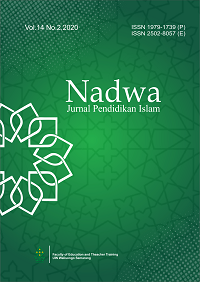
| Journal title | Nadwa: Jurnal Pendidikan Islam |
|---|---|
| Initials | NW |
| Abbreviation | Nadwa J. Pendidik. Islam |
| Language | English |
| Management Style | Open Access |
| Subject Areas | Islamic Education; Islamic Education Learning Strategies; Learning Media and Evaluation; Islamic Education Curriculum; Inclusive Islamic Education; Action Research in Islamic Education; History and Thought of Islamic Education; Islamic Education and Politics; Philosophy of Islamic Education. |
| Frequency | Twice a year (June and December) |
| DOI Prefix | 10.21580/nw |
| ISSN | 2502-8057 (online); 1979-1739 (print) |
| Publisher | Faculty of Education and Teacher Training |
| Editor-in-Chief | Agus Mutohar, Ph.D.     |
| Citation Analysis | Dimensions | Google Scholar |
Nadwa: Jurnal Pendidikan Islam (translated in English Nadwa: Islamic Education Journal) (P-ISSN 1979-1739 and E-ISSN 2502-8057) is a peer-reviewed, open-access journal published by the Faculty of Education and Teacher Training, Universitas Islam Negeri Walisongo Semarang, Indonesia. It publishes interdisciplinary scholarship on how Islamic knowledge, authority, identity, ethics and human formation are negotiated and transformed in postdigital societies.
Nadwa understands Islamic education broadly: as the intergenerational transmission, interpretation, embodiment and transformation of Islamic knowledge, values, practices and ways of being. This includes schools, madrasahs, pesantren and universities, as well as informal, communal, online and transnational learning environments such as majelis taklim, study circles, social media and AI-mediated religious learning.
By postdigital we mean a condition in which digital and non-digital life can no longer be meaningfully separated. Nadwa’s central concern is therefore not the adoption of technology in Islamic education, but how postdigital conditions reshape religious life, epistemic authority, ethical subjectivity and human flourishing.
The journal draws on religious studies, philosophy of religion, sociology and anthropology of religion, Islamic intellectual traditions, digital religion, postdigital theory and critical studies of artificial intelligence. It has particular strength in Southeast Asia and welcomes comparative work from across the Muslim world and Muslim-minority contexts.