

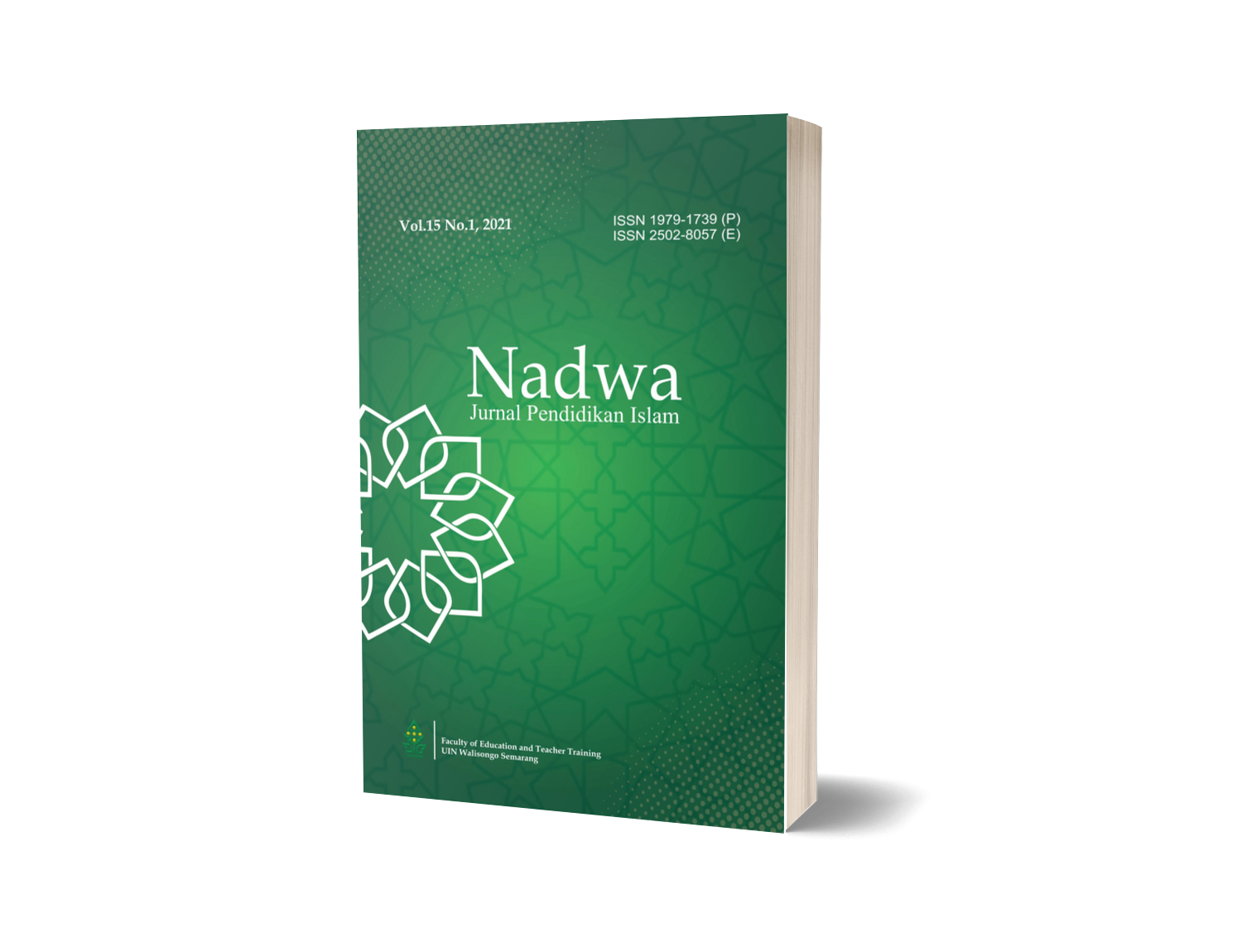
| Journal title | Nadwa: Jurnal Pendidikan Islam |
|---|---|
| Initials | NW |
| Abbreviation | Nadwa J. Pendidik. Islam |
| Frequency | Twice a year (June and December) |
| DOI Prefix | 10.21580/nw by  |
| ISSN | 2502-8057 (online); 1979-1739 (printed) |
| Editor-in-Chief | Agus Mutohar, Ph.D     |
| Citation Analysis | SINTA 2 | Google Scholar l DOAJ l More... |
Nadwa: Jurnal Pendidikan Islam (translated in English Nadwa: Islamic Education Journal) (P-ISSN 1979-1739 and E-ISSN 2502-8057) is an international journal published by Faculty of Education and Teacher Training, Universitas Islam Negeri Walisongo, Indonesia. The journal pursues the academic exploration on Indonesian Islamic education discourses such as schools, colleges, universities, and other Islamic educational institutions such as pesantrens (Islamic boarding schools) in Islamic education discourses. The journal promotes empirical research and theory relevant to Islamic-affiliated educational institutions. The topics of the journal cover the micro, meso, and macro levels of Islamic education such as the philosophy, Islamic school leadership, learning strategy, curriculum, learning evaluation, inclusive education, education based on culture, and the politics of Islamic education.
Nadwa is an open-access journal which means users are allowed to read, download, copy, distribute, print, search, or link to the full texts of the articles, or use them for any other lawful purpose, without asking prior permission from the author or the publisher. It means that all content is freely available without charge to the user or their institution.
Nadwa published twice a year always places Islamic Education in the central focus of academic inquiry and invites any discussions as the aim and scopes.
Nadwa has been indexed by:





Current Issue
Vol. 20 No. 1 (2026): Articles in Progress
We are pleased to present this volume, which explores contemporary transformations in Islamic education, including Virtual Reality integration, prophetic leadership, and critical gender discourse. These studies examine how traditional institutions navigate modernization while maintaining foundational ethical values. Collectively, this research provides vital empirical insights designed to inspire educators and policymakers worldwide.
A defining hallmark of this edition is its remarkable global footprint, uniting contributors from five countries across four continents to create a truly transnational narrative. By weaving together diverse perspectives from across Asia, Europe, Australia, and Africa, this collection transcends geographic boundaries to offer a rich, comprehensive, and global outlook on the future of Islamic education.
Published: 30-06-2026