Principles of Transparency and Best Practice in Scholarly Publishing
Jurnal Theologia, as a scholarly journal published by the Faculty of Ushuluddin and Humanities, Walisongo State Islamic University, Semarang, Indonesia, is committed to adhering to the Principles of Transparency and Best Practices in Scholarly Publishing developed by the Committee on Publication Ethics (COPE), OASPA, and WAME. These principles are designed to ensure integrity, transparency, and high quality in the publishing process. The following is an adaptation of these principles specifically implemented by Jurnal Theologia:
1. Journal Name
The name "Theologia" was chosen to be unique and not easily confused with other journals. This name reflects a focus on Islamic studies, particularly Islamic philosophy and theology, Qur'anic and Hadith studies, interfaith studies, Sufism, and Islamic ethics, without misleading authors or readers regarding the origin, scope, or affiliation with other journals or organizations. The journal does not imitate the name of another journal and clearly states its identity as a national journal based in Indonesia.
2. Website
The Jurnal Theologia website is well-supported and maintained, using the HTTPS protocol for security and redirecting all traffic through HTTPS to protect users from viruses and malware. We implement web standards and ethical best practices for content, presentation, and applications. The website does not contain misleading information, does not copy the design or logo of other journals/publishers, and acknowledges the source if any text is copied. Clearly displayed information includes the purpose and scope (Islamic studies with an emphasis on Islamic philosophy and theology, Qur'anic and Hadith studies, interfaith studies, Sufism, and Islamic ethics), target audience (academics, students, and religious practitioners), types of manuscripts accepted (original articles, reviews, and essays; duplicate or redundant publication is prohibited), authorship criteria, and the ISSNs for print (0853-3857) and electronic (2540-847X).
3. Publication Schedule
Jurnal Theologia publishes issues semi-annually (June and December) on a clear and consistent schedule. We are committed to adhering to this schedule, except in extraordinary circumstances, such as a pandemic or disaster, which will be announced on our website and via emails to stakeholders.
4. Archiving
Jurnal Theologia has a long-term electronic archiving and digital preservation plan, including submission to Garuda (the Digital Reference Portal) and DOAJ for open access. As a CrossRef member since 2016 with a unique DOI (prefix: 10.21580/teo) for each article, content will be preserved through services such as CLOCKSS or LOCKSS, as registered with the Keepers Registry, to ensure perpetual accessibility.
5. Copyright
Copyright terms for published content are clearly stated on the website and with each article. Copyright remains with the author, with the publisher retaining non-exclusive distribution rights. Copyright holders are acknowledged in the full text of all articles (HTML and PDF). Copyright forms are readily accessible to all parties through the manuscript submission page.
6. License
License information is clearly stated on the website and marked in the full text of articles (HTML and PDF). As an open-access journal, we use the Creative Commons Attribution-NonCommercial-ShareAlike 4.0 International (CC BY-NC-SA 4.0) license, with a direct link to the Creative Commons website. This license permits the use, distribution, and adaptation of the work with proper attribution, but not for commercial purposes, and derivatives must be shared under the same license. Our policy permits authors to post preprints and published versions of manuscripts in third-party repositories, as long as attribution is given.
7. Publication Ethics and Related Editorial Policies
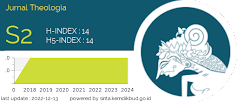
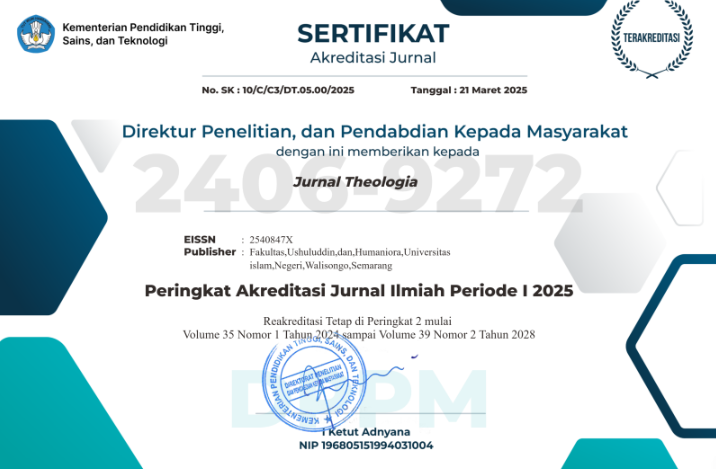
Jurnal Theologia has a publication ethics policy visible on its website, covering authorship and contributors, handling complaints and appeals, alleged research misconduct, conflicts of interest, data sharing and reproducibility, ethical oversight, intellectual property, post-publication discussions, and corrections and retractions. The editors and publisher ensure scientific integrity by following COPE guidelines for cases such as plagiarism, citation manipulation, and data falsification. The journal is accredited by the Ministry of Research, Technology, and Higher Education of the Republic of Indonesia based on Decree of the Director General of Higher Education, Research, and Technology Number 10/C/C3/DT.05.00/2025. This policy does not encourage or permit ethical violations.
8. Peer Review
Peer review involves advice from external experts outside the editorial team. This process is clearly stated on the website: all primary content is double-blind peer-reviewed by independent experts (at least two reviewers), using NISO terminology. The procedure includes reviewer recommendations by authors (with verification), anonymization, review of supplementary materials, anonymous review, the editorial board's decision-making process, and exceptions for editorial or book reviews (stated in the article). The journal does not guarantee early acceptance of manuscripts, supports statements of review timelines with publication data, notifies authors of delays with a withdrawal option, and publishes submission, acceptance, and publication dates.
9. Access
All Jurnal Theologia content is freely available (open access) without access, registration, or subscription fees. Print versions are available by special request for a minimal production fee, which is explained on the website.
10. Ownership and Management
Ownership and management information is clearly stated on the website: Jurnal Theologia is owned and managed by the Faculty of Ushuluddin and Humanities, Walisongo State Islamic University, Semarang, Indonesia. The organization's name is not misleading, and university affiliations and sponsors (if any) are accompanied by links to their respective websites.
11. Advisory Board
Jurnal Theologia has an editorial board and advisory board consisting of leading experts in the fields of theology, philosophy of religion, and Islamic studies. A complete list of the names, affiliations, and biographies of members who agree to serve is updated regularly on the website. Editor-in-Chief: Prof. Dr. Mohammad Nor Ichwan, M.Ag. The board is reviewed every two years to ensure relevance and avoid associations with predatory practices.
12. Editorial Team / Contact Information
Editor-in-Chief: Prof. Dr. Mohammad Nor Ichwan, M.Ag., (Universitas Islam Negeri Walisongo, Semarang, Indonesia), Jl. Prof. Dr. Hamka Km. 1, located on Campus II, Ngaliyan, Semarang, is listed on the website for ease of communication.
13. Author Fees
Jurnal Theologia does not charge submission, editorial processing, or publication fees (APCs) to support accessibility. This is clearly stated on the website and submission page. There are no plans to implement fees in the future, and editorial decisions are not influenced by financial factors.
14. Other Revenue
Jurnal Theologia's business model is funded by university and institutional grants, with no advertising, sponsorship, or resale influencing editorial decisions. All revenue sources are transparently declared on the website to avoid conflicts.
15. Advertising
Jurnal Theologia does not accept any advertising, either digital or print, to maintain editorial independence. This policy is clearly stated on the website.
16. Direct Marketing
Direct marketing efforts, such as invitations to submit manuscripts, are targeted (only to experts in the field of theology and Islamic studies), unobtrusive, honest, and not misleading about the publisher or the journal. We avoid mass emails and focus on academic networks.