The Role of the Education Office in Fostering Child-Friendly Schools
DOI:
https://doi.org/10.21580/jawda.v7i1.2026.29545Keywords:
child-friendly education; education governance; school safety; child protection”.Abstract
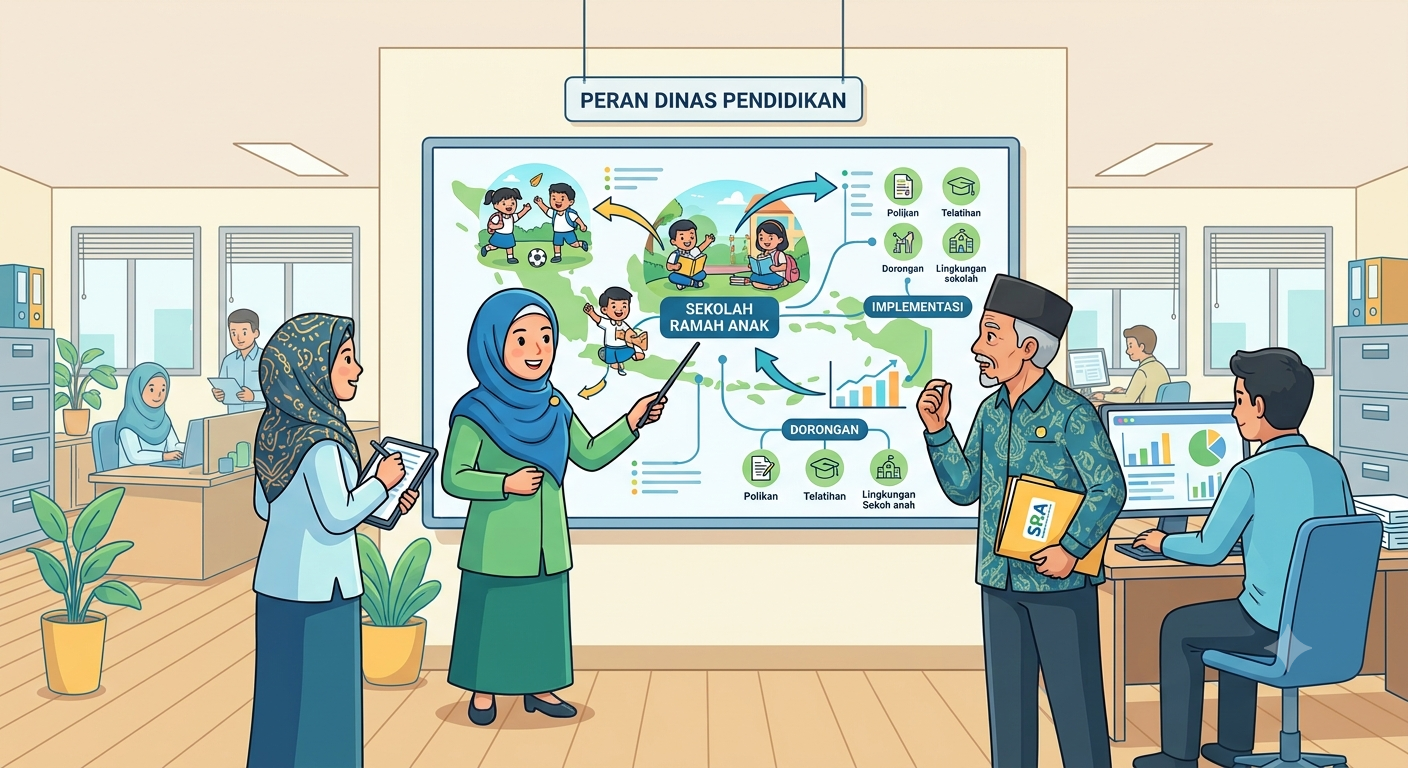
This study aims to analyze the role of the Sidoarjo Regency Education Office in fostering the implementation of Child-Friendly Schools (CFS). This research employed a qualitative descriptive approach, with data collected through in-depth interviews, observations, and documentation studies. The findings indicate that the Education Office plays a strategic role through preventive guidance, continuous socialization, responsive complaint-handling mechanisms with a maximum three-day response time, the establishment of School Violence Prevention and Handling Teams (TPPK), and cross-sector collaboration. These strategies demonstrate that the role of the Education Office extends beyond administrative functions to include governance and child protection responsibilities within the education system. This study contributes to the development of educational governance studies by highlighting the importance of local government involvement in strengthening child protection policies in schools.
Downloads
References
Artadianti and Subowo, "Implementation of Child-Friendly Schools (SRA) in Pilot Schools at SD Pekunden 01 Semarang City as an Effort to Support the Child-Friendly City (KLA) Program."
Baharun, Wibowo, and Hasanah, "Women's Leadership in Creating Child-Friendly Schools."
Dwi Hajar Fitri Astuti, “The Implementation Of Child-Friendly School Policies In Elementary Schools,” AJIS: Academic Journal of Islamic Studies 10, no. 1 (2025).
Endah Priyati Ning Tyas, Ahkmad Qomarun Zaman, and Bernaderta Budi Lestari, "ANALYSIS OF STRENGTHENING THE RELIGIOUS CHARACTER OF CULTURE-BASED STUDENTS AT KEMALA BHAYANGKARI 3 PORONG SMA SCHOOL," Educational Journal 8, no. 2 (2023): 15.
Eni Fariyatul Fahyuni, "Textbook of the Concept of Islamic Child-Friendly Schools," Umsida Press, 2020.
Fahyuni, "Textbook of the Concept of Islamic Child-Friendly Schools."
Global Status Report on Preventing Violence against Children 2020, accessed October 7, 2025, https://www.who.int/publications/i/item/9789240004191.
Hasan Baharun, Adi Wibowo, and Siti Nur Hasanah, "Women's Leadership in Creating Child-Friendly Schools," Quality 9, no. 1 (2021).
Ishak Bagea Et Al., Child-Friendly School Education Management (Cv. Azka Pustaka, 2025).
Kardius Richi Yosada and Agusta Kurniati, "Creating Child-Friendly Schools," Journal of Basic Education Perkhasa: Journal of Basic Education Research 5, no. 2 (2019).
Kardius Richi Yosada and Agusta Kurniati, "Creating Child-Friendly Schools," Journal of Basic Education Perkhasa: Journal of Basic Education Research 5, no. 2 (2019).
Kiki Artadianti and Ari Subowo, "Implementation of Child-Friendly Schools (SRA) in Pilot Schools at SD Pekunden 01 Semarang City as an Effort to Support the Child-Friendly City (KLA) Program," Journal of Public Policy and Management Review 6, no. 3 (2017).
Luluk Rachmatul Yasiro, Fitria Eka Wulandari, and Fahmi Fahmi, "Analysis of Students' Creative Thinking Ability in Solving Problems on Global Warming Materials Based on Student Achievement," Journal of Banua Science Education 1, no. 2 (2021).
M. Pd Jumakir, Child-Friendly Schools (umsu press, 2024), https://books.google.com/books?hl=id&lr=&id=3FMhEQAAQBAJ&oi=fnd&pg=PR7&dq=Jumakir,+M.+P.+(2024)+&ots=m6tn1H87la&sig=elyaHElStrMcgjxZQS4OA2BZ5aA.
MINISTRY OF WOMEN'S EMPOWERMENT AND, Child-Friendly School Guide, 2015, https://sekolahramahanak.wordpress.com/wp-content/uploads/2013/11/juknis-final-3-2-16-1.pdf.
Regulation of the Minister of Education and Culture Number 82 of 2015 concerning the Prevention and Prevention of Violence in Education Units, 2015.
Wiwin Yuliani, "Qualitative Descriptive Research Methods in the Perspective of Guidance and Counseling," QUANTA: Journal of Guidance and Counseling Studies in Education 2, no. 2 (2018).
Yosada and Kurniati, "Creating Child-Friendly Schools."
Downloads
Published
Issue
Section
License
Copyright (c) 2026 Jawda: Journal of Islamic Education Management

This work is licensed under a Creative Commons Attribution-ShareAlike 4.0 International License.
Authors who publish with this journal agree to the following terms:
Authors are able to enter into separate, additional contractual arrangements for the non-exclusive distribution of the journal's published version of the work (e.g., post it to an institutional repository or publish it in a book), with an acknowledgement of its initial publication in this journal.
Authors are permitted and encouraged to post their work online (e.g., in institutional repositories or on their website) prior to and during the submission process, as it can lead to productive exchanges, as well as earlier and greater citation of published work (See The Effect of Open Access).