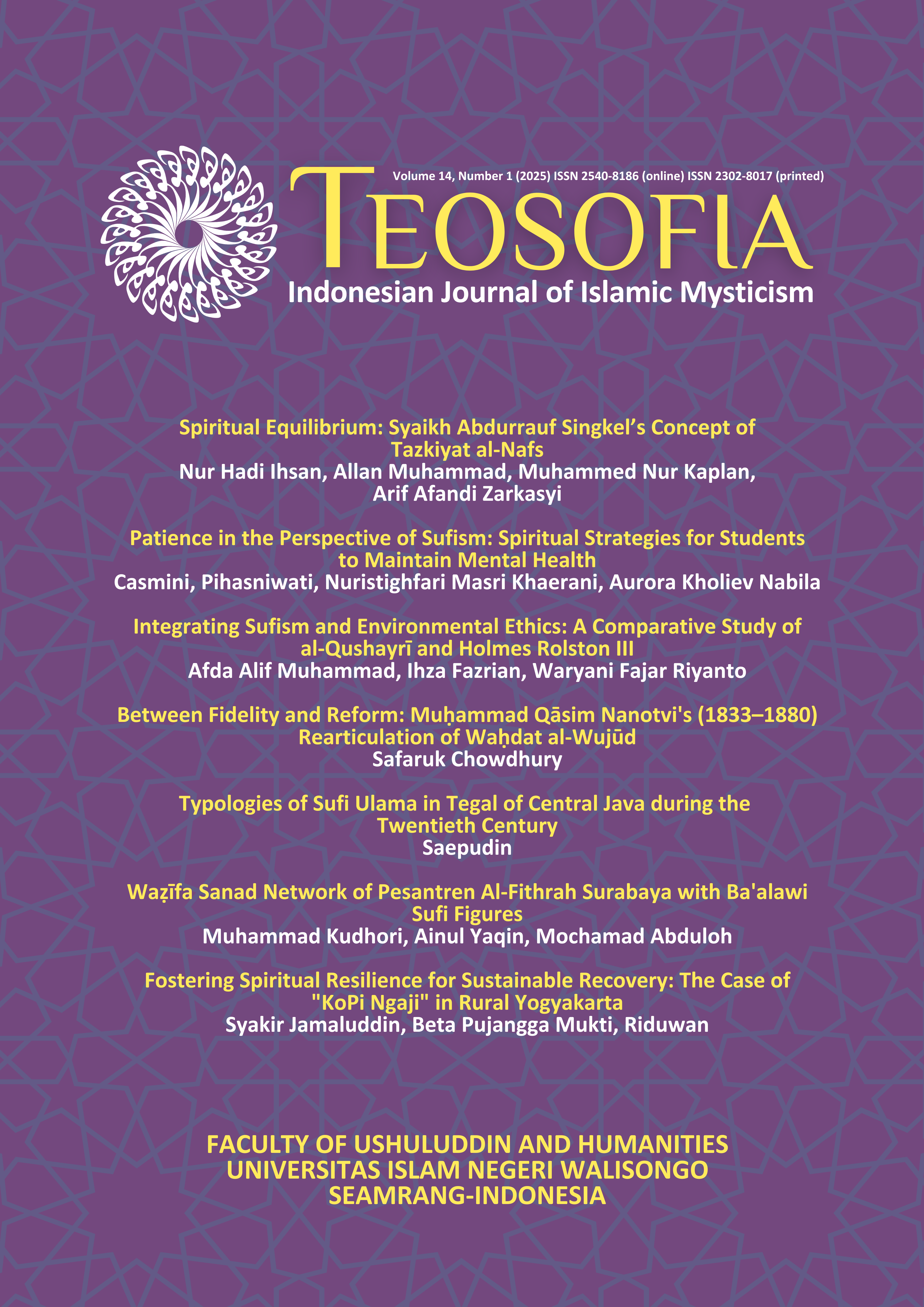
Fostering Spiritual Resilience for Sustainable Recovery: The Case of "KoPi Ngaji" in Rural Yogyakarta
DOI:
https://doi.org/10.21580/tos.v14i1.25641Keywords:
“KoPi Ngaji” program, faith-based community development, Spiritual Resilience, Islamic empowermentAbstract
Existing studies on post-crisis economic recovery tend to privilege technocratic and pragmatic empowerment models, thereby ignoring the role of religion and spirituality in sustainable community development. Addressing this gap, this study examines how “KoPi Ngaji” constructs a holistic model of faith-based community development by integrating spiritual, social, and economic dimensions. Employing a phenomenological approach, data were collected through in-depth interviews with seven respondents, including a program manager and congregants. The findings reveal that “KoPi Ngaji” operates through an integrative Head, Heart, and Hand (3H) framework, which functions as a cohesive empowerment architecture. It facilitates intellectual engagement through Islamic study, entrepreneurship workshops, and dialogical learning; nurtures emotional bonds, inclusive participation, and a shared sense of belonging; translates spiritual and social capital into concrete material and moral support. These three aspects synergize to cultivate spiritual resilience and enable sustainable community recovery.
Contribution: This study contributes to affirming that spiritual well-being can be the foundation of social and economic empowerment.
Downloads
References
Al-Attas, Syed Muhammad Naquib. The Concept of Education in Islam: A Framework for an Islamic Philosophy of Education. Kuala Lumpur: ISTAC, 1991.
Al-Ghazālī, Abū Ḥāmid Muḥammad. Iḥyā’ ꜤUlūm Al-Dīn. Beirut: Dār Ibn Ḥazm, 2005.
Babbie, Earl R. The Basics of Social Research. 6th ed. Cengage Learning, 2014.
Boyatzis, Richard E. Transforming Qualitative Information: Thematic Analysis and Code Development. Sage Publication, 1998.
BPS. “Persentase Penduduk Miskin September 2022 Naik Menjadi 9,57 Persen.” bps.go.id, 2023. https://www.bps.go.id/id/pressrelease/2023/01/16/2015/persentase-penduduk-miskin-september-2022-naik-menjadi-9-57-persen.html.
Choe, Jaeyeon, and Luh Putu Mahyuni. “Sustainable and Inclusive Spiritual Tourism Development in Bali as a Long-Term Post-Pandemic Strategy.” International Journal of Religious Tourism and Pilgrimage 11, no. 2 (2023): 100–110. https://doi.org/10.21427/BP1V-GZ27.
Chowdhury, Shofiqur Rahman, and M Rezaul Islam. “Revitalizing Community Empowerment: Harnessing the Synergy of Faith-Based NGOs and Laverack’s Domain Approach.” Community Development Journal 60, no. 2 (2025): 381–397. https://doi.org/10.1093/cdj/bsae018.
Coley, Linda, Elizabeth Stryon Howze, and Kyle McManamy. “Faith-Based Community-Academic Partnerships: An Asset-Based Community Development Strategy for Social Change.” Gateways: International Journal of Community Research and Engagement 16, no. 2 (2013): 1–19. https://doi.org/10.5130/ijcre.v16i2.8672.
Creswell, John W. Qualitative Inquiry and Research Design: Choosing Among Five Traditions. Sage Publication, 1998.
Cullen, W., G. Gulati, and B.D. Kelly. “Mental Health in the COVID-19 Pandemic.” QJM: An International Journal of Medicine 113, no. 5 (2020): 311–312. https://doi.org/10.1093/qjmed/hcaa110.
Dewey, John. Experience and Education. 1st ed. New York: Simon & Schuster, 1997.
Fahmi, Fikri Zul, and Medina Savira. “Digital Technologies and Rural Community Resilience: Learning From the COVID-19 Crisis in Indonesia.” Rural Society 34, no. 3 (2025): 236–25. https://doi.org/10.1080/10371656.2025.2495402.
Haddoud, Mohamed Yacine, Alamir Al-Aalawi, Ibrahim Al-Jubari, Sohail Amjed, and Ahmed Mohamed Elbaz. “Religiosity and Resilience in Entrepreneurship: Uncovering the Underlying Mechanism Through the Lens of Spiritual Capital.” International Journal of Entrepreneurial Behavior & Research 31, no. 5 (2025): 1287–1310. https://doi.org/10.1108/ijebr-02-2024-0187.
Hazza, Faishal. “Kopi Ngaji Bodeh Sleman: Jadilah Orang Tua Yang Asyik!” Kabar Muhammadiyah, 2023. https://kabarmuh.id/kopi-ngaji-bodeh-sleman-jadilah-orang-tua-yang-asyik/ .
Istiatin, and Fithri Setya Marwati. “Sosialisasi Berbagai Peluang Usaha Umkm Dan Ekonomi Kreatif Di Era New Normal Di Dusun Pinggir Desa Telukan Sukoharjo.” Budimas: Jurnal Pengabdian Masyarakat 3, no. 1 (2021): 129–40. https://jurnal.stie-aas.ac.id/index.php/JAIM/article/view/2027.
Jamaluddin, Syakir, Kunnu Purwanto, Hasan Ibnu Salam, and Nurul Jidan Ismail. “Inisiasi Pengajian Kopi Ngaji: Model Pemberdayaan Desa Agamis Dan Kreatif Di Desa Bodeh Ambarketawang Gamping Sleman.” In Digitalisasi Syiar Islam. Universitas Muhammadiyah Yogyakarta, 2022. https://doi.org/10.18196/ppm.56.926.
Koenig, Harold G. Religion and Mental Health: Research and Clinical Applications. New York: Academic Press, 2018.
Koenig, Harold G., Dana E. King, and Verna B. Carson, eds. Handbook of Religion and Health. Oxford: Oxford University Press, 2012.
Kruahong, Suratsawadee, Thitipong Tankumpuan, Kathleen Kelly, Patricia M. Davidson, and Premgamon Kuntajak. “Community Empowerment: A Concept Analysis.” Journal of Advanced Nursing 79, no. 8 (2023): 2845–2859. https://doi.org/10.1111/jan.15613.
Laverack, Glenn. “An Identification and Interpretation of the Organizational Aspects of Community Empowerment.” Community Development Journal 36, no. 2 (2001): 134–45. https://doi.org/10.1093/cdj/36.2.134.
Madjid, Nurcholis. Masyarakat Religius Membumikan Nilai-Nilai Islam Dalam Kehidupan. Jakarta: Dian Rakyat, 2010.
Manning, Lydia, Morgan Ferris, Carla Narvaez Rosario, Molly Prues, and Lauren Bouchard. “Spiritual Resilience: Understanding the Protection and Promotion of Well-Being in Later Life.” Journal of Religion Spirituality & Aging 31, no. 2 (2018): 168–86. https://doi.org/10.1080/15528030.2018.1532859.
Michie, Jonathan. “The Covid-19 Crisis and the Future of the Economy and Economics.” International Review of Applied Economics 34, no. 2 (2020): 301–3. https://doi.org/10.1080/02692171.2020.1756040.
Mukti, Beta Pujangga, and Achdiar Redy Setiawan. “Interpreting the Covid-19 Pandemic Issue from the Islamic Tasawwuf Perspective.” International Journal of Religious and Cultural Studies 2, no. 2 (2020): 47–58. https://doi.org/10.34199/ijracs.2020.10.02.
Nasr, Syed Hossein. The Hearth of Islam: Enduring Values for Humanity. Harper Collins, 2002.
Paloutzian, Raymond F., and Crystal L. Park. “Religiousness and Spirituality: The Psychology of Multilevel Meaning-Making Behavior.” Religion, Brain & Behavior 5, no. 2 (2012): 166–78. https://doi.org/10.1080/2153599X.2014.891254.
Pramudiya, Kelvin, Utoyo Osman Pelu, Fairuz Zahran Ardra, and Ernyasih Ernyasih. “Pelaksanaan Pengajian Di Masa Pandemi Covid-19.” In Prosiding Seminar Nasional Pengabdian Masyarakat LPPM UMJ, 127-. Jakarta: Universitas Muhammadiyah Jakarta, 2021. https://jurnal.umj.ac.id/index.php/semnaskat/article/view/10882.
Prior, Lindsay. Using Documents in Social Research. Sage Publication, 2003.
Setiawan, Achdiar Redy, and Beta Pujangga Mukti. “‘Kopi Ngaji’: Building A Holistic Village Community Development Model Based on Islamic Values.” Airlangga International Journal of Islamic Economics and Finance 6, no. 2 (2023): 85–96. https://doi.org/10.20473/aijief.v6i02.49911.
Setiawan, Wisnu, Rini Hidayati, Nur Rahmawati Syamsiyah, and Fauzi Mizan Prabowo Aji. “Post-Pandemic Resilient Rural Tourism in Yogyakarta: Community-Led Strategies Toward a Blue Economy.” In International Conference on Agricultural and Sustainability in Blue Economy (ICASBE 2025), 2025. https://doi.org/10.1051/bioconf/202518003007.
Shelton, Charlotte D., Sascha Hein, and Kelly A. Phipps. “Resilience and Spirituality: A Mixed Methods Exploration of Executive Stress.” International Journal of Organizational Analysi 28, no. 2 (2020): 399–416. https://doi.org/10.1108/IJOA-08-2019-1848.
Smith, Jonathan, Ginger Charles, and Ian Hesketh. “Developing Understanding of the Spiritual Aspects to Resilience.” International Journal of Public Leadership 11, no. 1 (2015): 34–45. https://doi.org/10.1108/IJPL-06-2014-0006.
Sofianto, A., and T. Risandewi. “Mapping of Potential Village-Owned Enterprises (BUMDs) for Rural Economic Recovery During the COVID-19 Pandemic in Central Java, Indonesia.” IOP Conference Series Earth and Environmental Science 887, no. 1 (2021). https://doi.org/10.1088/1755-1315/887/1/012022.
Suprima, Muhamad Parhan, Abizar Khairulimam, Mita Nurfitriyani, and Salza Nabila Ababil. “Dakwah Di Masa Pandemi Covid-19: Eksistensi, Problematika Serta Solusi.” Jurnal Ilmu Dakwah 41, no. 1 (2021): 85–96. https://doi.org/10.21580/jid.v41.1.8287.
Tambunan, Edwin Martua Bangun, and Floranesia Lantang. “The Pandemic Challenges for Traditional Communities at the Cross-Border Post Areas of the Republic of Indonesia-Papua New Guinea.” International Journal of Asia Pacific Studies 20, no. 1 (2024): 99–124. https://doi.org/10.21315/ijaps2024.20.1.5.
Tan, Da Yang, Eng Guan Tay, Kok Ming Teo, and Paul M. E. Shutler. “Hands, Head and Heart (3H) Framework for Curriculum Review: Emergence and Nesting Phenomena.” Educational Studies in Mathematics 102, no. 2 (2020): 189–210. https://doi.org/10.1007/s10649-020-10003-2.
Tarpeh, Samson, and Ronald Hustedde. “How Faith-Based Organizations Perceive Their Role in Community Development: An Exploratory Study.” Community Development 52, no. 1 (2021): 61–76. https://doi.org/10.1080/15575330.2020.1831565.
Tilaar, H.A.R. Perubahan Sosial Dan Pendidikan: Pengantar Pedagogik Transformatif Untuk Indonesia. Jakarta: Grasindo, 2002.
Ungar, Michael. The Social Ecology of Resilience: A Handbook of Theory and Practice. Springer, 2011.
Wahyuni, Esa Nur, and Khairul Bariyyah. “Apakah Spiritualitas Berkontribusi Terhadap Kesehatan Mental Mahasiswa?” Jurnal Educatio Jurnal Pendidikan Indonesia 5, no. 1 (2019): 46–53. https://doi.org/10.29210/120192334.
Warr, Peter, and Arief Anshory Yusuf. “Pandemic‐induced De‐urbanization in Indonesia: Urban and Rural Impacts.” The Developing Economies 62, no. 2 (2023): 139–74. https://doi.org/10.1111/deve.12392.
Widyawati. “Pandemi COVID-19 Memperparah Kondisi Kesehatan Jiwa Masyarakat.” kemkes.go.id, 2022. https://kemkes.go.id/id/pandemi-covid-19-memperparah-kondisi-kesehatan-jiwa-masyarakat.
Yusoff, N.S., M.F. Rashid, and N.A. Halim. “The Impact of Covid-19 Pandemic Towards Socioeconomic Wellbeing of Rural Community in Malaysia.” IOP Conference Series Earth and Environmental Science 1064, no. 1 (2022): 1–10. https://doi.org/10.1088/1755-1315/1064/1/012054.
Downloads
Published
How to Cite
Issue
Section
License

This work is licensed under a Creative Commons Attribution-ShareAlike 4.0 International License.
Copyright
The copyright of the received article shall be assigned to the journal as the publisher of the journal. The intended copyright includes the right to publish the article in various forms (including reprints). The journal maintains the publishing rights to the published articles. Therefore, the author must submit a statement of the Copyright Transfer Agreement.*)
Licensing

This work is licensed under a Creative Commons Attribution-ShareAlike 4.0 International License.
In line with the license, authors are allowed to share and adapt the material. In addition, the material must be given appropriate credit, provided with a link to the license, and indicated if changes were made. If authors remix, transform or build upon the material, authors must distribute their contributions under the same license as the original.
_______
*) Authors whose articles are accepted for publication will receive confirmation via email and send a Copyright Transfer Agreement.