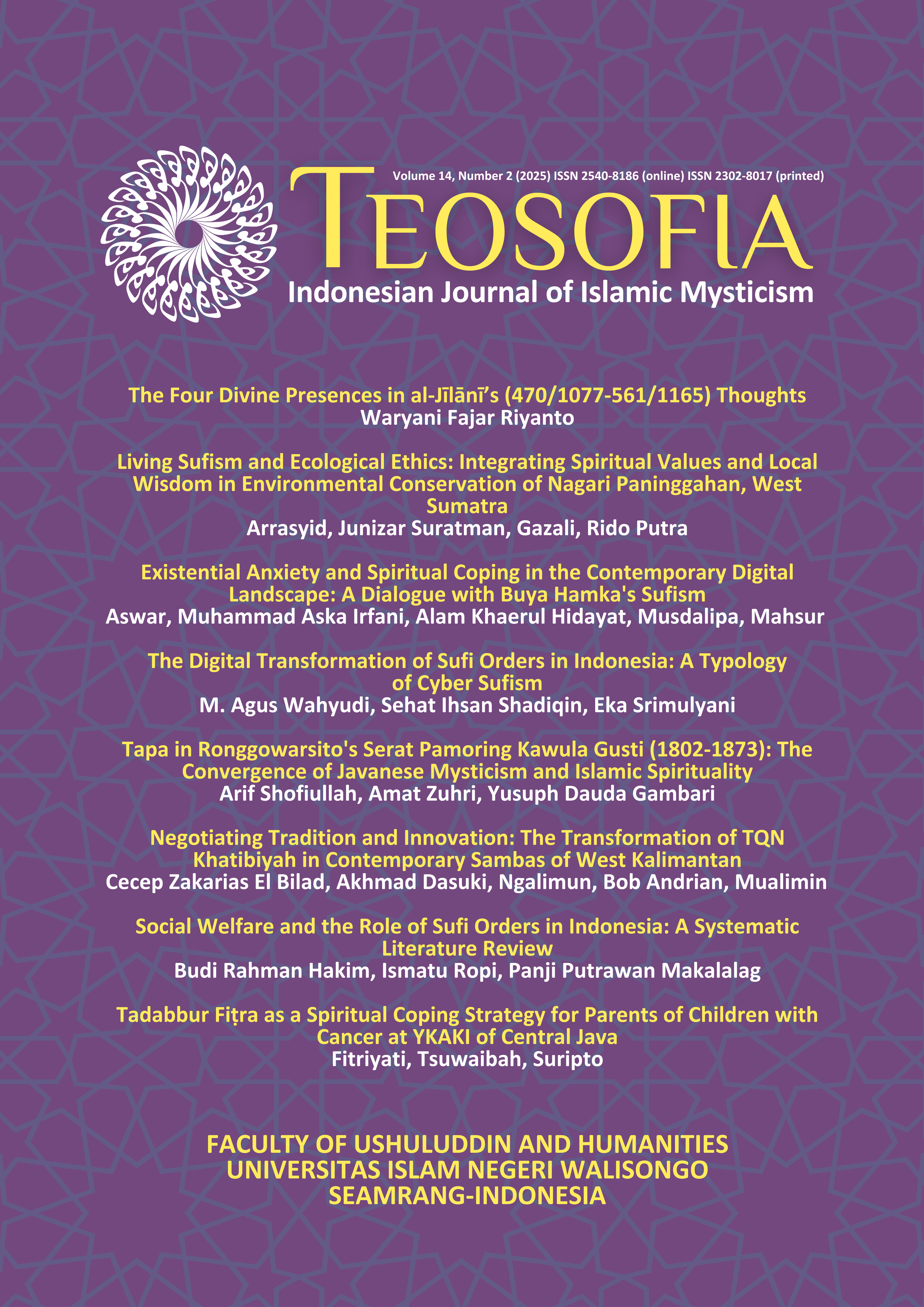
Existential Anxiety and Spiritual Coping in the Contemporary Digital Landscape: A Dialogue with Buya Hamka's Sufism
DOI:
https://doi.org/10.21580/tos.v14i2.27603Keywords:
existential anxiety, digital society, modern Sufism, spiritual coping, Buya HamkaAbstract
Existential anxiety has emerged as a growing concern in contemporary digital society, yet its spiritual dimension remains insufficiently explored. This study examines manifestations of existential anxiety and spiritual coping through the philosophical framework of Buya Hamka's Tasawuf Modern. Using a qualitative interpretive approach, it integrates digital content analysis of publicly accessible narratives from TikTok, X, Instagram, and Threads with philosophical textual analysis of Tasawuf Modern. The findings reveal three major manifestations of existential anxiety: loss of meaning in life, digital isolation, and uncertainty about the future, alongside four forms of spiritual coping: gratitude (shukr), contentment (qanā’ah), trust in God (tawakkal), and remembrance of God (dhikr). These findings highlight the relevance of Hamka's modern Sufism (Tasawuf Modern) as a philosophical framework for understanding spiritually grounded coping with existential anxiety in the digital era.
Contribution: This article contributes to the growing scholarship on existential anxiety by integrating empirical digital narratives with Buya Hamka's Tasawuf Modern. Rather than treating Hamka's thought as an empirically tested intervention, the study positions Tasawuf Modern as an interpretive philosophical framework for understanding contemporary forms of spiritual coping in digital society.
Downloads
References
Afifi, Mansur, Abdul Fattah, Mira Mareta, and Mohammad Fakhri. “DZIKR AND MEDITATION IN TASHAWWUF: Spiritual Disciplines, Psychological Benefits, and Their Contemporary Relevance.” MIQOT: Jurnal Ilmu-Ilmu Keislaman 49, no. 2 (December 10, 2025): 400–422. https://doi.org/10.30821/miqot.v49i2.1485.
Ahmad Fakhrurrazi Bin Mohammed Zabidi, Abu Yazid Bin Abdul Kadir, Nur Huraidah Binte Jumat, and Najamuddin Petta Solong. “Thematic Analysis of the Need for Sufism Education: Muslim Entrepreneurs’ Perspectives in Achieving a Prosperous Life.” Global Journal Al-Thaqafah, December 31, 2025, 237–54. https://doi.org/10.7187/GJATSI122025-16.
Aisyahrani, Asa Ismia Bunga, Lina Handayani, Maya Kusuma Dewi, and Mastura Mahfar. “A Concept of Materialism and Well-Being.” International Journal of Evaluation and Research in Education (IJERE) 9, no. 1 (March 1, 2020): 62. https://doi.org/10.11591/ijere.v9i1.20424.
Akdağ, Berhan, and Cansu Ünsal. “The Mediating Role of Self-Esteem Between Meaning in Life and Social Media Addiction.” ADDICTA: The Turkish Journal on Addictions 11, no. 1 (March 15, 2024): 99–104. https://doi.org/10.5152/ADDICTA.2024.23126.
Al-Barawi, Rahmatullah. “Buya Hamka, Penyelamat Tasawuf Dari Pemaknaan Yang Menyimpang.” ibtimes.id, 2024. https://ibtimes.id/buya-hamka-penyelamat-tasawuf-dari-pemaknaan-yang-menyimpang/.
Aldbyani, Aamer. “Islamic Mindfulness: A Response to Mindfulness and Religion.” Mindfulness 17, no. 3 (March 16, 2026): 972–77. https://doi.org/10.1007/s12671-026-02759-0.
Ali, Md. Memon, Mahbuba Akter Shanta, and Shihab Uddin Suman. “Hyper-Connectivity and Loneliness: A Thematic Analysis of Digital Relationships in the Modern World.” Contemporary Family Therapy, March 4, 2026. https://doi.org/10.1007/s10591-026-09779-x.
Astuti, Tia Agnes. “Tasawuf Modern Karya Buya Hamka Rekomendasi Bacaan Buat Anak Muda.” detikhot, 2026. https://hot.detik.com/book/d-6638788/tasawuf-modern-karya-buya-hamka-rekomendasi-bacaan-buat-anak-muda.
Azhimov, Bekzhan A, Nurlan Kairbekov, Jolaman Bulan, and Tussipkhan Imammadi. “Researching a New Religious Phenomenon of the Central Asia: Digital Sufism.” Occasional Papers on Religion in Eastern Europe 46, no. 1 (January 1, 2026): 90–110. https://doi.org/10.55221/2693-2229.2710.
Berman, Steven L., Carl F. Weems, and Timothy R. Stickle. “Existential Anxiety in Adolescents: Prevalence, Structure, Association with Psychological Symptoms and Identity Development.” Journal of Youth and Adolescence 35, no. 3 (2006): 285–92. https://doi.org/10.1007/s10964-006-9032-y.
Bruggen, Vincent van, Peter Ten Klooster, Gerben Westerhof, Joël Vos, Elian de Kleine, Ernst Bohlmeijer, and Gerrit Glas. “The Existential Concerns Questionnaire (ECQ)-Development and Initial Validation of a New Existential Anxiety Scale in a Nonclinical and Clinical Sample.” Journal of Clinical Psychology 73, no. 12 (December 2017): 1692–1703. https://doi.org/10.1002/jclp.22474.
Bruggen, Vincent Van, Joël Vos, Gerben Westerhof, Ernst Bohlmeijer, and Gerrit Glas. “Systematic Review of Existential Anxiety Instruments.” Journal of Humanistic Psychology 55, no. 2 (April 7, 2015): 173–201. https://doi.org/10.1177/0022167814542048.
Cetinkaya, Merve, and Jo Billings. “Systematic Review of the Relationship between Islamic-Sufi Spirituality and Practice and Mental Well-Being.” Mental Health, Religion & Culture 26, no. 10 (November 26, 2023): 1065–80. https://doi.org/10.1080/13674676.2023.2256265.
Channel, MJS. Ngaji Filsafat 477 : Buya Hamka - Tasawuf Modern, 2025. https://www.youtube.com/watch?v=erx0qIGqgu8&t=1052s.
Chowdury, Saeyd Rashed Hasan. “SUFISM IN CONTEMPORARY CONTEXTS: Spirituality, Subjectivity, and the Limits of Modern Rationality.” MIQOT: Jurnal Ilmu-Ilmu Keislaman 50, no. 1 (February 4, 2026): 1–32. https://doi.org/10.30821/miqot.v50i1.1566.
Counted, Victor, Kenneth I. Pargament, Andrea Ortega Bechara, Shaun Joynt, and Richard G. Cowden. “Hope and Well-Being in Vulnerable Contexts during the COVID-19 Pandemic: Does Religious Coping Matter?” The Journal of Positive Psychology 17, no. 1 (January 2, 2022): 70–81. https://doi.org/10.1080/17439760.2020.1832247.
David, Laura Teodora, and Camelia Truţa. “Well-Being and Internal Resources during the COVID-19 Pandemic in Relation to Meaning in Life and Existential Anxiety.” Frontiers in Psychology 14 (August 25, 2023). https://doi.org/10.3389/fpsyg.2023.1168641.
Frankl, Viktor E. Man s Search For Meaning. Beacon Press, 2017.
Fuad, Ai Fatimah Nur. “Navigating Modernity: Hamka’s Responses To The Challenges Of Secularism And Materialism.” Jurnal Penelitian Humaniora 25, no. 2 (September 21, 2024): 81–90. https://doi.org/10.23917/humaniora.v25i2.23487.
Gazali, Hidayatul Azizah, and Sefri Auliya. “Social Relations in Minangkabau Society from Hamka’s Perspective in Tafsir Al-Azhar.” Sophist : Jurnal Sosial Politik Kajian Islam Dan Tafsir 6, no. 1 (2024): 20–50. https://doi.org/10.20414/sophist.v6i1.114.
Graça, Lídia, and Tânia Brandão. “Religious/Spiritual Coping, Emotion Regulation, Psychological Well-Being, and Life Satisfaction among University Students.” Journal of Psychology and Theology 52, no. 3 (2024): 342–58. https://doi.org/10.1177/00916471231223920.
Hamka, Buya. Tasawuf Modern. Edited by Muh. Iqbal Santosa. Jakarta: Republika Penerbit, 2015.
Huang, Chengli, and Chao Hu. “The Terror Management and Sorrow Management of Death Consciousness.” Acta Psychologica Sinica 55, no. 2 (2023): 318. https://doi.org/10.3724/SP.J.1041.2023.00318.
Jamarudin, Ade, Asmal May, and Ofa Ch Pudin. “The Prospect of Human in the Exegetical Work: A Study of Buya Hamka’s Tafsir Al-Azhar.” Ulumuna 23, no. 1 (June 28, 2019): 24–47. https://doi.org/10.20414/ujis.v23i1.360.
Joseph, Jemimal Joys, Hariharasudan Anandhan, Mykolas Deikus, and Jolita Vveinhardt. “Mapping the Landscape of Religious Coping: Review and Bibliometric Analysis of Theocentric and Non-Theocentric Practices.” Journal of Religion and Health 65, no. 1 (February 10, 2026): 290–313. https://doi.org/10.1007/s10943-025-02466-5.
Josephson, Allan M. Spiritually Integrated Psychotherapy: Understanding and Addressing the Sacred. Journal of Psychiatric Practice. Vol. 15. New York, NY: Guilford Press, 2009. https://doi.org/10.1097/01.pra.0000348370.26795.a0.
Kesebir, Pelin, and Tom Pyszczynski. “The Role of Death in Life: Existential Aspects of Human Motivation.” In The Oxford Handbook of Human Motivation, 43–64. Oxford University Press, 2012. https://doi.org/10.1093/oxfordhb/9780195399820.013.0004.
Khafifah, Wilson Wilson, and Agustina Arundina Triharja Tejoyuwono. “Hubungan Tingkat Stres, Kecemasan, Dan Depresi Dengan Konstipasi Fungsional Pada Mahasiswa Kedokteran.” Jurnal Penyakit Dalam Indonesia 11, no. 1 (2024): 24–34. https://doi.org/10.7454/jpdi.v11i1.1529.
Kho, Sonah. “Waiting Amidst Uncertainty: A Humanistic‐Existential Approach to Anxiety.” The Journal of Humanistic Counseling 65, no. 1 (April 19, 2026): 2–10. https://doi.org/10.1002/johc.70024.
Komaruddin, Didin. “Konsep Tasawuf Modern Dalam Pemikiran Nasaruddin Umar.” Syifa Al-Qulub 2, no. Januari (2019): 96–111. https://doi.org/10.15575/saq.v3i2.3535.
Li, Jingjin, Karen Anne Cochrane, and Gilly Leshed. “Beyond Meditation: Everyday Mindfulness and Technology Use Among Experienced Practitioners.” In CHI Conference on Human Factors in Computing Systems Extended Abstracts, 1:1–6. New York, NY, USA: ACM, 2022. https://doi.org/10.1145/3491101.3519820.
Li, Kai, Shanshan Jiang, Xingde Yan, and Jie Li. “Mechanism Study of Social Media Overload on Health Self-Efficacy and Anxiety.” Heliyon 10, no. 1 (January 2024): e23326. https://doi.org/10.1016/j.heliyon.2023.e23326.
Markum, Robert B., and Kentaro Toyama. “Digital Technology, Meditative and Contemplative Practices, and Transcendent Experiences.” In Proceedings of the 2020 CHI Conference on Human Factors in Computing Systems, 1–14. New York, NY, USA: ACM, 2020. https://doi.org/10.1145/3313831.3376356.
Miles, Matthew B., and A. Michael Huberman. Qualitative Data Analysis: An Expanded Sourcebook. 2nd ed. Thousand Oaks, CA: Sage Publications., 2000.
Mitha, Karim. “Sufism and Healing.” Journal of Spirituality in Mental Health 21, no. 3 (July 3, 2019): 194–205. https://doi.org/10.1080/19349637.2018.1464423.
Mora Galeote, Juan José. “From the Aesthetics of Existence to the Supernormal Aesthetics of Existence: The Birth of a Projected-Digital Self.” Revista de Humanidades, no. 56 (September 1, 2025): 149–78. https://doi.org/10.5944/rdh.56.2025.43851.
Nikoy Kouhpas, Elyas, Zeinab Karimi, Bahman Rahmani, and Fatemah Shoaee. “The Relationship Between Existential Anxiety and Demoralization Syndrome in Predicting Psychological Well-Being of Patient With Cancer.” Practice in Clinical Psychology 8, no. 3 (2020): 175–82. https://doi.org/10.32598/jpcp.8.3.515.1.
Nilyati. “Peranan Tasawuf Dalam Kehidupan Modern.” TAJDID: Jurnal Ilmu Ushuluddin 14, no. 1 (2015): 119–42. https://doi.org/10.30631/tjd.v14i1.24.
Prameswari, Dyah Ayu, and Linusia Marsih. “Forms of Existential Crisis in Haruki Murakami’S Norwegian Wood: Toru Watanabe Analysis.” Prosodi 17, no. 2 (2023): 171–75. https://doi.org/10.21107/prosodi.v17i2.19821.
Qorib, Fathul, and Mert Gürer. “Digital Identity Formation Among Generation Z in Turkey: A Mixed-Methods Study in Manuel Castells’ Network Society.” Jurnal Komunikasi: Malaysian Journal of Communication 42, no. 1 (March 31, 2026): 203–21. https://doi.org/10.17576/JKMJC-2026-4201-12.
Rahim, Fathor, and Hasnan Bachtiar. “Hamka’s Neo-Sufism in the Context Modern Society.” Journal of Social Studies (JSS) 19, no. 1 (April 5, 2023): 1–14. https://doi.org/10.21831/jss.v19i1.57513.
Reed, David E., Rachel E. Williamson, and Robert E. Wickham. “Memento Mori: Understanding Existential Anxiety through the Existential Pathway Model.” Journal of Theoretical Social Psychology 5, no. 1 (January 17, 2021): 14–25. https://doi.org/10.1002/jts5.79.
Robingatun, Fidia Astuti, and Abdul Wasik. “Sufism Revisited: A Comprehensive Analysis of Emha Ainun Najib’s Philosophical Contributions to Modern Society.” Journal of Islamic Thought and Civilization 14, no. 1 (June 14, 2024): 352–71. https://doi.org/10.32350/jitc.141.21.
Rozi, Syafwan, Nurlizam, and M. Zubir. “The Reception of Hamka’s Tafsir Al-Azhar within Social Religious Issues in the Malay World.” Jurnal Studi Ilmu-Ilmu Al-Qur’an Dan Hadis 25, no. 2 (August 30, 2024): 247–72. https://doi.org/10.14421/qh.v25i2.5406.
Sa’adah, Diana Zumrotus. “Konseling Eksistensial Humanistik Untuk Mengurangi Kecemasan Terhadap Masa Depan.” Procedia : Studi Kasus Dan Intervensi Psikologi 8, no. 3 (2020): 112–18. https://doi.org/10.22219/procedia.v8i3.14303.
Salihin. “Pemikiran Tasawuf Hamka Dan Relevansinya Bagi Kehidupan Modern.” Institut Agama Islam Negeri (IAIN) Bengkulu, 2016.
———. “Pemikiran Tasawuf Hamka Dan Relevansinya Bagi Kehidupan Modern.” Manthiq 1, no. 2 (2016): 179–90. https://doi.org/10.29300/mtq.v1i2.344.
Sopiyan, Lukman Wawan. “Contribution Of Contemporary Tasawuf As An Alternative Solution To Overcoming Religious Spiritual Drought.” El-Ghiro: Jurnal Studi Keislaman 22, no. 2 (2024): 209–19. https://doi.org/10.37092/el-ghiroh.v22i2.892.
Sulistyani, Syarifah Lubis, M. Irfan Khalifaur, and Gusman Lesmana. “Application of a Humanistic Existential Counseling Approach to Reducing Adolescents’ Anxiety for the Spiritual Future.” Indonesian Journal of Advanced Research 2, no. 8 (2023): 1209–40. https://doi.org/10.55927/ijar.v2i8.5484.
Sun, Mimi, Xia Tian, Yunyi Peng, Zheng Wang, Yongmei Lu, and Wenli Xiao. “Effects of Meaning Therapy on Spirituality, Psychological Health, and Quality of Life in Patients with Cancer: A Systematic Review and Meta-Analysis of Randomized Controlled Trials.” Asia-Pacific Journal of Oncology Nursing 11, no. 4 (April 2024): 100388. https://doi.org/10.1016/j.apjon.2024.100388.
Syauqi, Muhammad. “Tasawuf Sebagai Terapi Menemukan Makna Spiritual Dalam Hidup Modern.” Ameena Journal 1, no. 4 (2023): 359–70. https://ejournal.ymal.or.id/index.php/aij/article/view/40%0Ahttps://ejournal.ymal.or.id/index.php/aij/article/download/40/37.
Syefriyeni, Syefriyeni, and Dindin Nasrudin. “The Construction of Environmental Philosophy Rooted in Religiosity.” HTS Teologiese Studies / Theological Studies 79, no. 2 (August 25, 2023): 1–7. https://doi.org/10.4102/hts.v79i2.8442.
Tian, Jinrui, Boxuan Li, and Ronghua Zhang. “The Impact of Upward Social Comparison on Social Media on Appearance Anxiety: A Moderated Mediation Model.” Behavioral Sciences 15, no. 1 (December 26, 2024): 8. https://doi.org/10.3390/bs15010008.
Tobing, Mario Excel Elfando, Nurwahidin, and Anggi Setiawan. “Relevansi Tasawuf Amali Dan Tasawuf Falsafi Pada Masa Modern.” Nizham 11, no. 2 (2023): 1–13. https://doi.org/10.32332/nizham.v11i02.7103.
Twenge, Jean. M. “More Time on Technology, Less Happiness? Associations between Digital-Media Use and Psychological Well-Being.” Current Directions in Psychological Science 28, no. 4 (2019): 372–78. https://doi.org/https://doi.org/10.1177/0963721419838244.
Visic, Maroje. “Bauman’s Metaphors in Motion: The Tourist Metaphor and Digital Nomadism.” Sociologija 67, no. 3 (2025): 362–77. https://doi.org/10.2298/SOC2503362V.
White, Cindel J. M., and Abigail Ramos. “God, Are You There? Coping and Emotion Regulation Among Religious, Never Religious, and Formerly Religious People Experiencing a Spiritual Crisis.” The International Journal for the Psychology of Religion 36, no. 1 (January 2, 2026): 270–86. https://doi.org/10.1080/10508619.2025.2521574.
Wu, Han. “Existentialist Philosophies of Anxiety: A Comparative Exploration of Kierkegaard and Heidegger.” Lecture Notes in Education Psychology and Public Media 61, no. 1 (2024): 85–89. https://doi.org/10.54254/2753-7048/61/20240475.
Downloads
Published
How to Cite
Issue
Section
License

This work is licensed under a Creative Commons Attribution-ShareAlike 4.0 International License.
Copyright
The copyright of the received article shall be assigned to the journal as the publisher of the journal. The intended copyright includes the right to publish the article in various forms (including reprints). The journal maintains the publishing rights to the published articles. Therefore, the author must submit a statement of the Copyright Transfer Agreement.*)
Licensing

This work is licensed under a Creative Commons Attribution-ShareAlike 4.0 International License.
In line with the license, authors are allowed to share and adapt the material. In addition, the material must be given appropriate credit, provided with a link to the license, and indicated if changes were made. If authors remix, transform or build upon the material, authors must distribute their contributions under the same license as the original.
_______
*) Authors whose articles are accepted for publication will receive confirmation via email and send a Copyright Transfer Agreement.