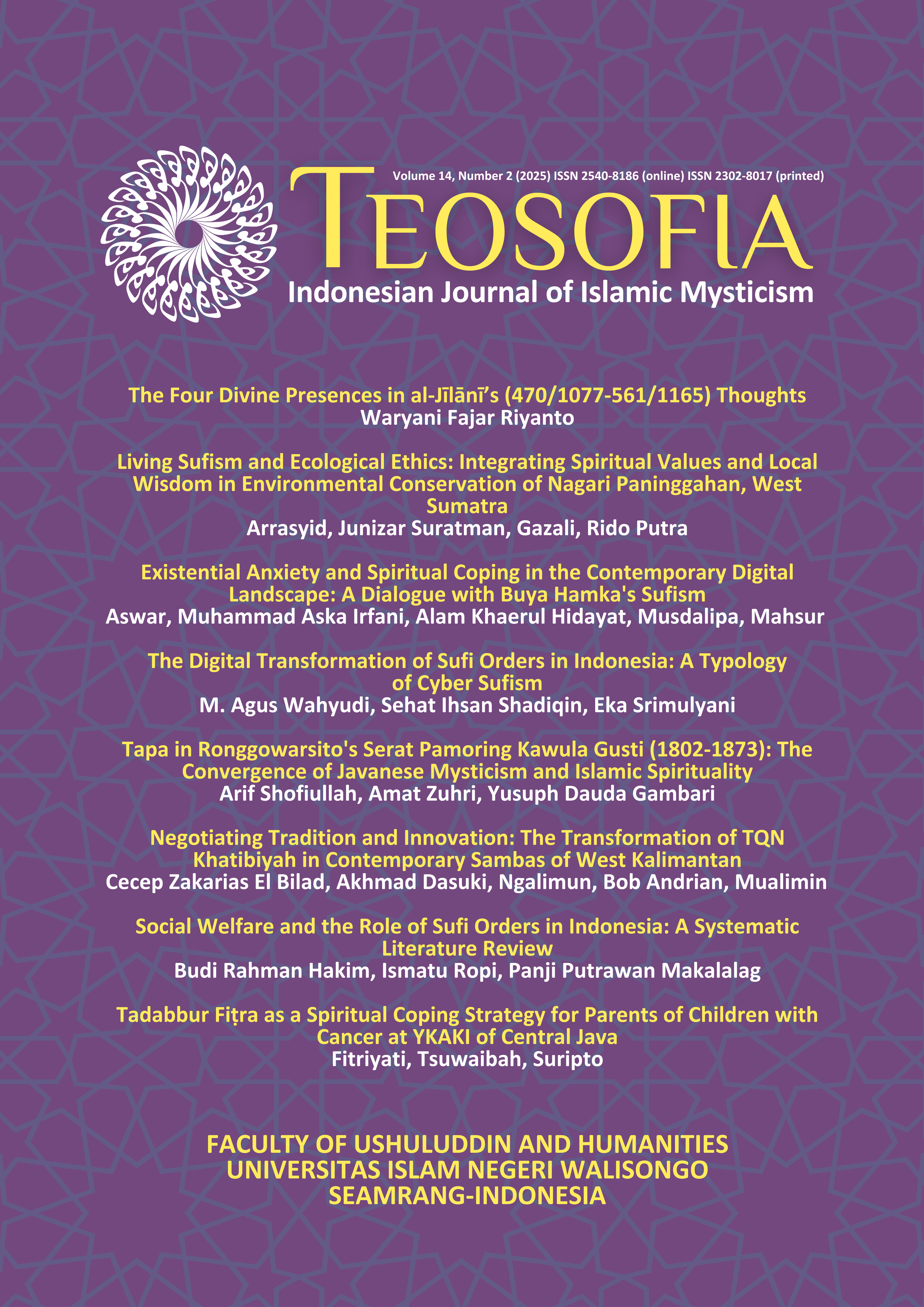
The Digital Transformation of Sufi Orders in Indonesia: A Typology of Cyber Sufism
DOI:
https://doi.org/10.21580/tos.v14i2.28356Keywords:
Cyber-sufism, digital zāwiya, sufi order, cyberspaceAbstract
Despite the rapid expansion of digital religious platforms, little is known about how Indonesian Sufi orders have adapted their spiritual practices to cyberspace. This study examines the development of Cyber-Sufism in Indonesia by identifying the typology of digital practices among Sufi orders. Using virtual ethnography and qualitative content analysis, it analyzes the official websites and digital platforms of nine Indonesian Sufi orders selected through purposive sampling. The findings identify two major types of Cyber-Sufism. The informative type, represented by the Qadiriyya wa Naqshbandiyya, Shadhiliyya, Tijaniyya, Syattariyya, Idrisiyya, Sammaniyya, and Rifa'iyya orders, primarily employs digital media for one-way dissemination of Sufi teachings, literature, organizational information, and institutional activities. Meanwhile, the interactive type, represented by the Naqshbandi Haqqani order, enables reciprocal spiritual engagement through online bayʿah, dhikr, ṣuḥbah, spiritual consultation, and virtual religious gatherings. The study concludes that the Naqshbandi Haqqani order exemplifies the most comprehensive model of interactive Cyber-Sufism through its digital zāwiya, which facilitates continuous spiritual learning, guidance, and religious engagement in the digital sphere.
Contribution: This study contributes to understanding the transformation of Sufi authority, religious learning, and spiritual interaction in the digital age, while offering a conceptual framework for mapping contemporary digital Sufism in Indonesia.
Downloads
References
Aceh, Abubakar. Pengantar Ilmu Tarekat: Uraian Tentang Mistik. Solo: Ramdhani, 1985.
Achmad, Zainal Abidin, and Rachmah Ida. “Etnografi Virtual Sebagai Teknik Pengumpulan Data Dan Metode Penelitian.” The Journal of Society & Media 2, no. 2 (2018): 130. https://doi.org/10.26740/jsm.v2n2.p130-145.
Amirudin, Muhammad Faizul. “Lembaga Pendidikan Kaum Sufi: Zawiyah, Ribath, Dan Khanqah.” El-Ghirah: Jurnal Studi Keislaman 12, no. 1 (2017): 116–29. https://doi.org/10.37092/el-ghiroh.v12i1.30.
Asmarani, Dini, and Sarah Monica. “Transnational Tariqa: The Expansion of Naqshbandī Haqqânî and the Fulfilment of Urban Spirituality.” Ulul Albab: Jurnal Studi Islam 24, no. 2 (2023): 232–55. https://doi.org/10.18860/ua.v24i2.23630.
Bruinessen, Martin Van. Kitab Kuning Pesantren Dan Tarekat. Yogyakarta: Gading Publishing, 2012.
———. Tarekat Naqsyabandiyah Di Indonesia. Bandung: Mizan, 1996.
Bunt, Gary R. Hashtag Islam: How Cyber Islamic Environments Are Transforming Religious Authority. Chapel Hill: University of North Carolina Press, 2019.
———. IMuslims: Rewiring the House of Islam. University of North Carolina Press, 2009.
Campbell, Heidi A. “Religion and the Internet: A Microcosm for Studying Internet Trends and Implications.” New Media and Society 15, no. 5 (2013): 680–94. https://doi.org/10.1177/1461444812462848.
———. “Understanding the Relationship between Religion Online and Offline in a Networked Society.” Journal of the American Academy of Religion 80, no. 1 (2012): 64–93. https://doi.org/10.1093/jaarel/lfr074.
Campbell, Heidi A., and Ruth Tsuria. Digital Religion: Understanding Religious Practice in New Media Worlds. New York: Routledge, 2022.
Cheong, Pauline Hope. “The Vitality of New Media and Religion: Communicative Perspectives, Practices, and Changing Authority in Spiritual Organization.” New Media & Society 19, no. 1 (May 31, 2016): 25–33. https://doi.org/10.1177/1461444816649913.
Cheruvallil-Contractor, Sariya. “Online Sufism – Young British Muslims, Their Internet ‘selves’ and Virtual Reality.” In Sufism in Britain, edited by Ron Geaves and Theodore Gabriel, 76–151. London: Bloomsbury Academy, 2013.
Donets, Pol, and Nataliya Krynytska. “Here Be Dragons: The Evolution of Cyberspace from William Gibson to Neal Stephenson.” American, British and Canadian Studies 38, no. 1 (2022): 76–98. https://doi.org/10.2478/abcsj-2022-0005.
Dudoignon, Stéphane A. “Chapter 22 Cyber Sufism.” In Sufi Institutions, 405–14. Leiden, The Netherlands: Brill, 2020. https://doi.org/https://doi.org/10.1163/9789004392601_024.
Hakim, Putri Rahmah Nur, Margo Teguh Sampurno, Irwan Abdullah, Najib Kailani, and Yuniar Galuh Larasati. “Digital Sufism: The Transformation of Piety in Gus Ulil’S Online Teachings.” Khazanah: Jurnal Studi Islam Dan Humaniora 22, no. 2 (2024): 191–218. https://doi.org/10.18592/khazanah.v22i2.13872.
Hasibuan, Armyn, Ismail Fahmi Arrauf Nasution, and Mowafg Masuwd. “Tarekat in the Digital Age: Transforming Spirituality for the Age of Technology.” Religia: Jurnal Ilmu-Ilmu Keislaman 27, no. 01 (2024): 13–30. https://doi.org/10.28918/religia.v27i1.2306.
Hegazy, W. “Cyber Sufis: Virtual Expressions of the American Muslim Experience (Islam in the Twenty‐First Century).” CyberOrient, 2020. https://doi.org/10.1002/j.1804-3194.2020.tb00005.x.
Hegazy, Wael. “Cyber Sufis: Virtual Expressions of the American Muslim Experience (Islam in the Twenty‐First Century).” CyberOrient 14, no. 2 (2020): 99–103. https://doi.org/10.1002/j.1804-3194.2020.tb00005.x.
Helland, Christopher. “Online Religion or Religion Online and Virtual Communitas.” In Religion on the Internet: Research Prospects and Promises, edited by Jeffrey K. Hadden and Douglas E. Cowan, 205–23. London: JAI Press / Elsevier Scince, 2000.
Hidayat, Ziaulhaq. “Transformasi Sufism Into Digital Media: Eshaykh and Simplification of Tarekat Orthodoxy.” Epistemé: Jurnal Pengembangan Ilmu Keislaman 17, no. 2 (2022): 197–223. https://doi.org/10.21274/epis.2022.17.2.197-223.
Hidayat, Ziaulhaq, and Achyar Zein. “Sufism and Virtual Piety a Narration of the Millennial Murshid in North Sumatra.” Journal of Indonesian Islam 16, no. 1 (2022): 133–52. https://doi.org/10.15642/JIIS.2022.16.1.133-152.
Hidayati, Dahlia. “Online Sufism and Reestablishing Religious Authority.” Ulumuna 26, no. 1 (2022): 204–37. https://doi.org/10.20414/ujis.v26i1.488.
Hine, Christine. Ethnography for the Internet: Embedded, Embodied and Everyday. 1st ed. London: Routledge, 2020. https://doi.org/https://doi.org/10.4324/9781003085348.
Howell, Julia Day. “Sufism and the Indonesian Islamic Revival.” The Journal of Asian Studies 60, no. 3 (2001): 701–29. https://doi.org/10.2307/2700107.
Karamustafa, Ahmet T. Sufism: The Formative Period. Edinburgh University Press, 2007.
Khotimah, Khusnul, Amirotun Solikhah, and Zidan Abid Maulana. “Virtual Sufism Identity in Majelis Kalbun Salim (MKS).” Teosofia: Indonesian Journal of Islamic Mysticism 13, no. 2 (2024): 269–302. https://doi.org/10.21580/tos.v13i2.23598.
Lings, Martin. What Is Sufism? London: George Allen and Unwin Ltd, 1975.
Lohlker, Rüdiger, and Soleh H Wahid. “The Transformation of Islamic Religious Authority.” Religions, 2026. https://doi.org/10.3390/rel17040493.
Overall, Jeffrey. “Self-Inquiry at a Distance: A Qualitative Study of Spiritual Emergence in a 7-Day Virtual Retreat.” Journal of Spirituality in Mental Health, 2025, 1–33. https://doi.org/10.1080/19349637.2025.2504958.
Piraino, Francesco. “Between Real and Virtual Communities: Sufism in Western Societies and the Naqshbandi Haqqani Case.” Social Compass 63, no. 1 (March 1, 2016): 93–108. https://doi.org/10.1177/0037768615606619.
Rahman, Fazlur. Islam. Chicago: The University of Chicago Press, 1979.
Rozehnal, Robert. “Chapter 5 Cyber Sufism in the Global West.” In Sufism in Western Contexts. Leiden, The Netherlands: Brill, 2023. https://doi.org/https://doi.org/10.1163/9789004392625_007.
———. Cyber Muslims: Mapping Islamic Digital Media in the Internet Age. Edited by Robert Rozehnal. New York: Bloomsbury Publishing, 2022.
———. Cyber Sufis: Virtual Expressions of the American Muslim Experience (Islam in the Twenty-First Century). United Kingdom: Oneworld Academic, 2019.
Shadiqin, Sehat Ihsan, and Shabrun Jamil. “Mediatisasi Sufisme: Otoritas, Komunitas, Dan Autentisitas Tasawuf Di Dunia Maya.” Substantia: Jurnal Ilmu-Ilmu Ushuluddin 26, no. 2 (2024): 273–88. https://doi.org/10.22373/substantia.v26i2.26654.
Syafaq, Hammis, Masdar Hilmy, and Achmad Fageh. “Digital Islamic Studies in Indonesia: Ontological, Epistemological and Axiological Perspectives.” Afkār 28, no. 1 (2026): 157–204. https://doi.org/10.22452/afkar .vol28no1.5.
Taufik, Zulfan, and Muhammad Taufik. “Mediated Tarekat Qadiriyah Wa Naqshabandiyah in the Digital Era: An Ethnographic Overview.” Esensia: Jurnal Ilmu-Ilmu Ushuluddin 22, no. 1 (2021): 35–43. https://doi.org/10.14421/esensia.v22i1.2511.
Trimingham, J. Spencer. The Sufi Orders in Islam. Oxford: Clarendon Press, 1998.
Wagner, Rachel. Godwired: Religion, Ritual and Virtual Reality. London: Routledge, 2011. https://doi.org/10.4324/9780203148075.
Wahyudi, M. Agus, Eka Srimulyani, Sehat Ihsan Shadiqin, and Randi Muhammad Gumilang. “Vernacular Cyber-Sufism: Digital Ritual, Mediated Authority, and the Naqshbandi Haqqani Order in Indonesia.” Teosofi: Jurnal Tasawuf Dan Pemikiran Islam 15, no. 2 (2025): 406–28. https://doi.org/10.15642/teosofi.2025.15.2.406-428.
Wahyudi, M Agus, Eka Srimulyani, Sehat Ihsan Shadiqin, and Randi Muhammad Gumilang. “Vernacular Cyber-Sufism: Digital Ritual, Mediated Authority, and the Naqshbandi Haqqani Order in Indonesia.” Teosofi: Jurnal Tasawuf Dan Pemikiran Islam 15, no. 2 SE-Articles (December 1, 2025): 406–28. https://doi.org/10.15642/teosofi.2025.15.2.406-428.
Downloads
Published
How to Cite
Issue
Section
License

This work is licensed under a Creative Commons Attribution-ShareAlike 4.0 International License.
Copyright
The copyright of the received article shall be assigned to the journal as the publisher of the journal. The intended copyright includes the right to publish the article in various forms (including reprints). The journal maintains the publishing rights to the published articles. Therefore, the author must submit a statement of the Copyright Transfer Agreement.*)
Licensing

This work is licensed under a Creative Commons Attribution-ShareAlike 4.0 International License.
In line with the license, authors are allowed to share and adapt the material. In addition, the material must be given appropriate credit, provided with a link to the license, and indicated if changes were made. If authors remix, transform or build upon the material, authors must distribute their contributions under the same license as the original.
_______
*) Authors whose articles are accepted for publication will receive confirmation via email and send a Copyright Transfer Agreement.