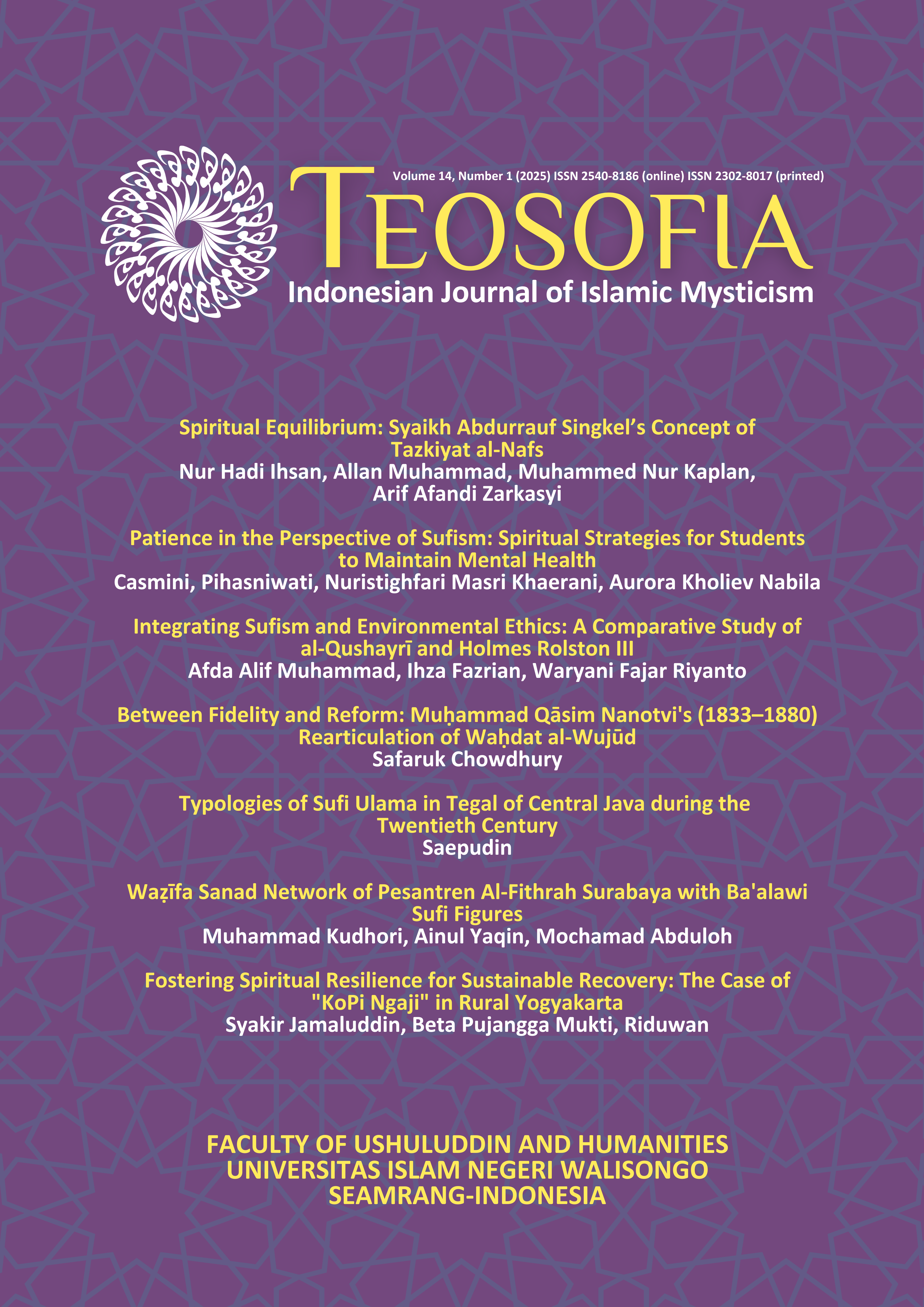
Waẓīfa Sanad Network of Pesantren Al-Fithrah Surabaya with Ba'alawi Sufi Figures
DOI:
https://doi.org/10.21580/tos.v14i1.28365Keywords:
waẓīfa, Al-Fithrah, Kiai Asrori, TQN al-‘Utsmaniyyah, Ba‘alawi SufiAbstract
Pesantren Al-Fithrah Surabaya, established by KH. Ahmad Asrori al-Ishaqi functions not only as an educational center but also as a hub for the Tariqa Qadiriyya wa Naqshbandiyya al-Utsmaniyyah (TQN al-‘Utsmaniyyah). Waẓīfa, spiritual practices, rooted in Sufi Ba’alawi tradition, have become a necessity for students in this pesantren. This study aims to uncover the spiritual chain (sanad) of the waẓīfa and to reveal why Ba‘alawi Sufi works are widely used at Pesantren Al-Fithrah. Using a qualitative approach, the data were collected from library research, field observations, and interviews. For analysis, it applies descriptive-analytical methods. The findings indicate that the practice of waẓīfa is rooted in Ba‘alawi Sufi traditions, due to some factors, including love (maḥabba) for Ba‘alawi as the descendants of Prophet Muhammad, Kiai Asrori’s lineage with Ba‘alawi Sufi figures, the connection of tariqa between Kiai Asrori and Ba‘alawi figures, and kinship ties between Kiai Asrori and Ba‘alawi Sufi figures.
Contribution: This study contributes to revealing the waẓīfa sanad network of Pesantren Al-Fithrah Surabaya, which serves as a TQN al-Utsmaniyyah headquarters while adopting many spiritual practices, especially those derived from the works of Ba'alawi Sufi figures.
Downloads
References
‘Ali bin Muhammad bin Husain al-Habsyi. Diwan Al-Imam Al-Habsyi. Seiwun: Maktabah Turats al-Imam al-Habsyi, n.d.
‘Ali bin Yahya al-Haddadi. “Makanat Ahl Al-Bait Wa Huquqihim ’Inda Ahl Al-Sunnah Wa Al-Jama’ah,” 2016. https://www.haddady.com/wp-content/uploads/2016/03/مكانة-أهل-البيت-وحقوقهم.pdf.
‘Aydrus bin ‘Umar al-Habsyi. Aqd Al-Yawaqit Al-Jawhariyyah. Tarim: Dar al-‘Ilm wa al-Da’wah, 2009.
‘Umar bin Muhammad bin Salim bin Hafidh. Al-Dliya’ Al-Lami’. Surabaya: Pondok Pesantrean Assalafi Al-Fithrah, n.d.
Aam Abdillah. “Sha’ā’ir Qirā’ah Rawātib Al-Ḥaddād Fī Indūnīsīyā: Dirāsah Tamhīdīyah.” Studia Islamika 10, no. 3 (2003): 149–69. https://doi.org/10.15408/sdi.v10i3.626.
Abdullah, A. Fatikhul Amin, and Yudi Prasetyo. “Educational Models and Strengthening Spiritual Values at Al Fithrah Islamic Boarding School Surabaya During the Covid-19 Pandemic.” In Proceedings of the 5th International Conference on Islamic Studies, 27–38. Pemekasan: IAIN Madura, 2021. https://doi.org/10.19105/iconis.v5i1.212.
Abdulloh Hanif, and Silviana. “Pembinaan Tasawuf Dalam Kegiatan Bimbingan Konseling Santri Putri Pondok Pesantren Assalafi Al Fithrah Surabaya.” Khidmatuna: Jurnal Pengabdian Masyarakat 1, no. 1 (2022): 24–35. https://doi.org/10.36781/khidmatuna.v1i1.344.
Abduloh, Mochamad. “Implementasi Wazifah Sebagai Upaya Pembentukan Sikap Spiritual Santri (Studi Kasus Di Pondok Pesantren Assalafi Al Fithrah Surabaya).” UIN Sunan Ampel Surabaya, 2016.
Abidin, Ali Zainal. “Qasidah ‘Salamullahi Ya Sadah’, Dibaca Saat Ziarahi Makam Wali.” Nu Online, 2024.
Abu Bakr bin ‘Abdullah al-‘Aydarus al-‘Adni. Diwan Al-‘Adni. Beir: Dar al-Hawi, 2011.
Achmad Imam Bashori, Muhammad Nurush Shobah, and Imam Ubaidillah. “Eksistensi Pesantren Tarekat Di Tengah Radikalisme Beragama.” PUTIH: Jurnal Pengetahuan Tentang Ilmu Dan Hikmah 8, no. 1 (2023): 27–40. https://doi.org/10.51498/tk1xx438.
Akh Bukhari. “PRESERVING ARAB TRADITION: The Cultural Expression of Habsyian in East Kalimantan.” Journal of Indonesian Islam 11, no. 1 (2017): 247–66. https://doi.org/10.15642/JIIS.2017.11.1.247-266.
Al-Alusi, Mahmud bin ‘Abdillah al-Husaini. Ruh Al-Ma’ani. Beirut: Dar al-Kutub al-‘Ilmiyyah, n.d.
Al-Ghazali, Abu Hamid. Ihya’ ’Ulum Al-Din. Semarang: Toha Putra, n.d.
Al-Habsyi, ‘Ali bin Muhammad bin Husain. Simth Al-Durar, 2010. https://archive.org/details/smt-alddorr/page/n5/mode/2up.
Al-Haddad, ’Abdullah bin ‘Alawi. Diwan Al-Imam Al-Haddad. Dar al-Hawi, 1993.
Al-Haddar, Muhammad bin ‘Abdullah. Al-Nafahat Al-Ramadlaniyyah. Tarim: Dar al-‘Ilm wa al-Da’wah, 2010.
Al-Harani, Ibn Taymiyyah. Majmu’ Al-Fatawa. Edited by ’Amir al-Jazzar Anwar al-Baz. Dar al-Wafa’, 2005.
Al-Ishaqi, Ahmad Asrori. Al-Faidl Al-Rahmani. Surabaya: Al-Khidmah, 2010.
———. Al-Muntakhabat Fi Rabithat Al-Qalbiyyah Wa Shillat Al-Ruhiyyah. Surabaya: Idarah al-Thariqah al-Qadiriyyah Wa al-Naqsyabandiyyah al-‘Utsmaniyyah, 2015.
———. Al-Wazhaif Al-Yaumiyyah Wa Al-Lailiyyah. Surabaya: Al Wava Publishing, 2020.
———. Apakah Manaqib Itu? Surabaya: Wava, 2010.
———. “Poster Silsilah Nasab KH. Muhammad Utsman Al-Ishaqi.” Surabaya, n.d. https://drive.google.com/file/d/1neG1KVAhwdFI_NFFCLoTTW0oAUnFvlvF/view?usp=sharing.
Al-Kahali, Samih Jamal. Rabi’ Al-Ridla, n.d.
Al-Muhdlar, Ahmad bin Muhammad bin ‘Alawi. Hadlrah Umm Al-Mu’minin Al-Sayyidah Khadijah Al-Kubra, n.d.
Amin al-Kurdi. Tanwir Al-Qulub. Beirut: Dar al-Kutub al-‘Ilmiyyah, 1995.
As’ad, Muhammad. “The Dinamics Of the Indonesian Hadramis On The Maulid Celebration.” Qudus International Journal of Islamic Studies (QIJIS) 8, no. 2 (2022). https://doi.org/http://dx.doi.org/10.21043/qijis.v8i2.6586.
Ba‘alawi, ‘Abdullah bin Husayn bin Thahir. Majmu’ Al-Habib ‘Abdullah Bin Husain Bin Thahir Ba‘Alawi. Damaskus: Dar al-Sanabil, 2008.
Basri, Ahmad Faizal. Terapi Psiko-Spiritual Dalam Selawat Al-Husainiyyah. Yogyakarta: Penerbit Samudra Biru, 2023.
Fuadi, Moh. Ashif, Latif Kusairi, Dawam Multazamy Rohmatulloh, and Adrian Perkasa. “Traces of Hadramaut’s Intelectualism in the 20thcentury in Nusantara Andthe Role of Its Pesantren Alumni.” Jurnal Lektur Keagamaan 20, no. 1 (2022): 227–58. https://doi.org/10.31291/jlka.v20i1.1036.
Hanif, Rosidi Rosidi dan Abdulloh. “He Motives of Muhammadiyah Community Following the Majlis Dzikir of Al-Khidmah: Case Study of Tarekat Community of Al-Qadiriyyah Wa Al-Naqsyabandiyyah Al-Utsmaniyyah.” International Journal of Islamic Thought and Humanities 2, no. 2 (2023): 210–221. https://doi.org/10.54298/ijith.v2i2.103.
Muhammad bin al-Husain al-Ajuri. Al-Syari’ah, n.d.
Muhammad Fayiz al-Durrah. Al-Mawa’id Al-Haniyyah Fima Yutla Wa Yuqra’ Fi Al-Majalis Al-Muhammadiyyah. Damaskus, n.d.
Muhammad Hasyim Asy’ari. Al-Nur Al-Mubin Fi Mahabbat Sayyid Al-Mursalin, n.d.
Nashiruddin. “Pendidikan Tarekat Perspektif KH. Achmad Asrori Al-Ishaqi Dan Relevansinya Terhadap Tujuan Pendidikan Nasional.” PUTIH: Jurnal Pengetahuan Tentang Ilmu Dan Hikmah 3, no. 1 (2018).
Pondok Pesantren Al-Salafi Al-Fithrah. Al-Nafahat Fima Yata’allaq Bi Al-Tarawih Wa Al-Witr Wa La-Tasbih Wa Al-Hajah. Surabaya: Pondok Pesantren Assalafi Al-Fithrah, 2023.
Riyadi, Abdul Kadir. “The Concept of Man in Ahmad Asrori’s Anthropology of Tasawuf.” Journal of Indonesian Islam 11, no. 1 (July 9, 2017): 223–46. https://doi.org/10.15642/JIIS.2017.11.1.223-246.
Sayyi, Ach. “Implementasi Model Pendidikan Sufistik Tarekat Qadiriyyah Wa Naqsyabandiyyah Dalam Pendidikan Islam Di Pondok Pesantren Assalafi Al-Fithrah Surabaya.” UIN Maulana Malik Ibrahim Malang, 2014.
Syamsul Rijal. “Revitalizing Hadhrami Authority: New Networks, Figures and Institutions among Ḥabā’ib in Indonesia.” STUDIA ISLAMIKA 27, no. 2 (2020): 239–72. https://doi.org/10.36712/sdi.v27i2.9382.
Syarifah, Maskuri, Junaidi Mistar, Saiful Anwar, and Nurul Azizah. “Fostering Tolerance Through the Hidden Curriculum: An Ethnographic Study of Inclusive Education in an Indonesian Islamic Boarding School.” Munaddhomah: Jurnal Manajemen Pendidikan Islam 6, no. 4 (2025): 603–617. https://doi.org/10.31538/munaddhomah.v6i4.1960.
Wahid, Soleh Hasan. “Rebuilding Ḥabāʾib Authority in the Digital Age in Indonesia: Jamāʿah Relations, Social Action, and Transparency.” Cogent Arts & Humanities 12, no. 1 (2025): 1–24. https://doi.org/10.1080/23311983.2025.2508025.
Downloads
Published
How to Cite
Issue
Section
License

This work is licensed under a Creative Commons Attribution-ShareAlike 4.0 International License.
Copyright
The copyright of the received article shall be assigned to the journal as the publisher of the journal. The intended copyright includes the right to publish the article in various forms (including reprints). The journal maintains the publishing rights to the published articles. Therefore, the author must submit a statement of the Copyright Transfer Agreement.*)
Licensing

This work is licensed under a Creative Commons Attribution-ShareAlike 4.0 International License.
In line with the license, authors are allowed to share and adapt the material. In addition, the material must be given appropriate credit, provided with a link to the license, and indicated if changes were made. If authors remix, transform or build upon the material, authors must distribute their contributions under the same license as the original.
_______
*) Authors whose articles are accepted for publication will receive confirmation via email and send a Copyright Transfer Agreement.