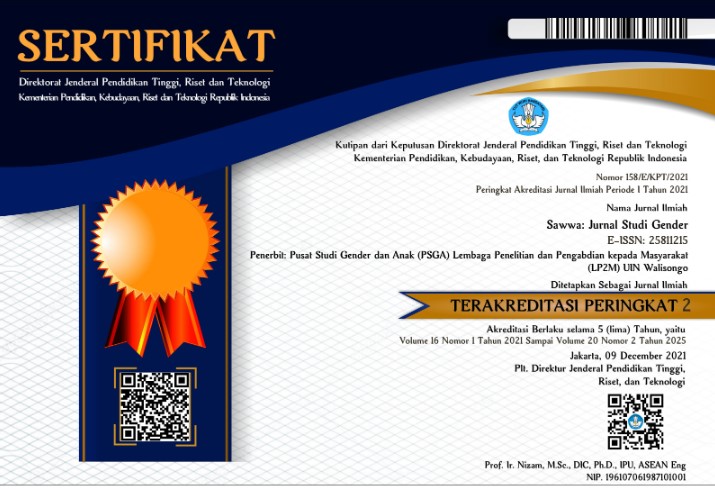
Accredited on SINTA 2
based on Decree No. 158/E/KPT/2021
dated December 27th, valid until 2025


Sawwa: Jurnal Studi Gender promotes integrity, fairness, and transparency in scholarly publishing, including the appropriate attribution of authorship and recognition of contributions. This policy establishes authorship requirements, outlines authors’ responsibilities, and explains how other contributions should be acknowledged. It seeks to ensure that individuals who contribute substantially to the intellectual development of a manuscript receive appropriate recognition and accept responsibility for their work.
The journal’s approach to authorship is informed by guidance from the Committee on Publication Ethics (COPE) and the International Committee of Medical Journal Editors (ICMJE), applied to the context of gender studies and related disciplines.
Authorship provides academic recognition and entails responsibility for the accuracy and integrity of the published work. An author must have made a substantial intellectual contribution to the research and manuscript and must satisfy all authorship requirements outlined below.
Contributorship covers assistance with research or manuscript preparation that merits recognition but does not fulfill all requirements for authorship.
Sawwa: Jurnal Studi Gender does not permit the following practices:
Gift, guest, or honorary authorship: Including individuals as authors because of their position, reputation, institutional influence, personal relationships, or anticipated reciprocal benefits when they do not meet the authorship requirements.
Ghost authorship: Omitting individuals whose contributions qualify them for authorship or concealing substantial writing or editorial assistance that should be disclosed.
Denial of authorship: Excluding individuals who fulfill all authorship requirements, including contributors whose work may be overlooked because of unequal academic, institutional, or social relationships.
Authors are expected to describe contributions transparently and allocate credit fairly. Academic seniority, institutional position, gender, or access to funding must not determine authorship eligibility.
Every person listed as an author must meet all four of the following requirements:
Make a substantial contribution to the conception or design of the study, or to the acquisition, analysis, or interpretation of its data, sources, or research materials.
Draft the manuscript or critically revise it for significant intellectual content.
Approve the final version intended for publication.
Accept accountability for the work and cooperate in investigating and resolving concerns about the accuracy or integrity of any part of it.
All individuals who fulfill these four requirements must be included as authors. Contributors who satisfy the first requirement should be given a reasonable opportunity to participate in manuscript revision and final approval.
Contributors who do not meet all four authorship requirements should be recognized in the Acknowledgments section, with a description of their assistance where appropriate.
Contributions that, on their own, do not establish eligibility for authorship include:
Securing research funding.
Providing general supervision or administrative support.
Assisting with transcription, translation, technical editing, language revision, or proofreading.
Conducting routine data collection without further substantial intellectual involvement.
Facilitating access to research materials, archives, communities, or participants.
Providing other technical or logistical support.
Research participation alone does not establish authorship. Any acknowledgment of participants, community members, or organizations must respect consent, confidentiality, and applicable research ethics commitments.
The corresponding author must obtain permission from everyone identified by name in the Acknowledgments section.
The authors must collectively agree on the sequence of names before submitting the manuscript. Sawwa: Jurnal Studi Gender does not prescribe a particular author order, as conventions differ across disciplines and research teams.
The agreed order should reflect a fair assessment of contributions. Authors may be asked to explain the rationale for their arrangement.
One author must be designated as the corresponding author and serve as the primary contact throughout submission, peer review, publication, and post-publication correspondence.
The corresponding author is responsible for:
Confirming that every listed author meets the journal’s authorship requirements.
Ensuring that all authors approve the submission, relevant revisions, and final version for publication.
Keeping co-authors informed of editorial decisions and manuscript progress.
Verifying author names, affiliations, contact information, and competing interest disclosures.
Coordinating responses to editorial requests and post-publication questions.
These coordinating duties do not replace the individual responsibilities of other authors.
Requests to add or remove an author, or to alter the author order after submission, must be submitted to the Editor-in-Chief by the corresponding author.
Each request must include:
A clear explanation of the proposed change.
Written agreement from all authors, including anyone being added or removed.
An updated author contribution statement, where applicable.
The journal may pause manuscript processing while a request is assessed. Authorship changes after acceptance will be considered only in exceptional circumstances and require approval from the Editor-in-Chief. Changes approved after publication will normally be documented through a formal correction.
Authors are encouraged to include an Author Contributions statement explaining each author’s role in the research and preparation of the manuscript.
The CRediT (Contributor Roles Taxonomy) framework may be used to describe these roles. Contribution statements support transparency but do not replace the journal’s authorship requirements.
Gift, guest, honorary, and ghost authorship are prohibited. Every listed author must satisfy the journal’s authorship requirements, and qualifying contributors must not be excluded.
Substantial writing or editorial assistance must be disclosed, together with its funding source where relevant. Artificial intelligence tools cannot qualify as authors because they cannot approve publication or accept responsibility for the work. Authors remain responsible for all submitted content and must transparently disclose relevant use of such tools in accordance with the journal’s applicable policies.
For manuscripts submitted by a research group, network, or consortium, the collective name may appear in the author list where appropriate. The submission must also identify the individual members who meet all authorship requirements and specify their contributions.
Individuals credited as authors must each fulfill the authorship requirements; membership in a research group alone is insufficient. Other members may be recognized as collaborators or acknowledged contributors. The corresponding author must clearly identify the individuals responsible for communication and accountability.
During submission, the corresponding author must confirm that:
All listed authors meet the journal’s authorship requirements.
No qualifying author has been omitted.
All authors have reviewed and approved the submitted manuscript.
All authors consent to submission to Sawwa: Jurnal Studi Gender.
The journal may request a separate authorship declaration, an author contribution statement, or supporting documentation.
Research teams should discuss authorship eligibility, responsibilities, and author order at the beginning of a project. These arrangements should be reviewed as contributions develop or team membership changes.
Written records of authorship agreements are recommended. Discussions should provide all contributors with a fair opportunity to explain their roles, including junior researchers and contributors outside established academic institutions.
The journal does not ordinarily adjudicate disagreements over who qualifies for authorship. Authors will be asked to resolve such disputes within their research team or through the relevant institutions.
Editorial assessment or publication may be suspended until the journal receives adequate evidence that the dispute has been resolved.
When a credible authorship concern is reported after publication, the journal will assess it in accordance with relevant COPE guidance. This may involve seeking explanations from the individuals concerned and requesting an investigation by their institutions.
Depending on the findings and their implications for the scholarly record, the journal may publish a correction or take other appropriate editorial action. An expression of concern or retraction may be considered where the circumstances warrant it; an authorship disagreement alone does not automatically justify retraction.
Authors should familiarise themselves with relevant COPE and ICMJE guidance and comply with applicable authorship requirements established by their institutions and funding bodies.
Where requirements differ or appear inconsistent, authors should inform the editorial office so that the matter can be clarified before publication.
All authors must take responsibility for their own contributions and have confidence in the integrity of their co-authors’ contributions. They must cooperate with reasonable requests to clarify methods, sources, findings, or other aspects of the published work and help resolve any substantiated concerns.
Sawwa: Jurnal Studi Gender may request further explanations or documentation concerning authorship and contributorship at any stage of submission, review, publication, or post-publication assessment. This policy supports fair recognition, transparent collaboration, and accountability in scholarly research.
Focus and Scope Peer Review Process Publishing Frequency Publication Ethics Open Access Policy Allegation of Research Misconduct Post Publication Discussion Correction and Retraction Copyright Licensing Revenue Sources, Advertising, and Direct Marketing Policies Author Fees (APC) Archiving Policy Authorship Criteria Conflict of Interest Generative AI Policies

Published by Center for Gender and Child Studies, Institute for Research and Community Services (LP2M), Universitas Islam Negeri Walisongo Semarang, Indonesia
Jl Prof. Dr. Hamka Kampus III Ngaliyan Semarang 50185
Phone: +628122779236
Website: https://lppm.walisongo.ac.id/
Email: [email protected]
This work is licensed under a Creative Commons Attribution-NonCommercial-ShareAlike 4.0 International License




