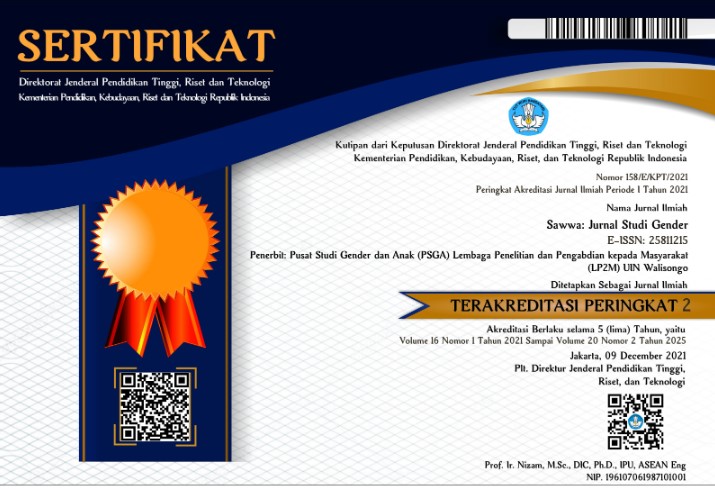
Accredited on SINTA 2
based on Decree No. 158/E/KPT/2021
dated December 27th, valid until 2025


Sawwa: Jurnal Studi Gender publishes corrections when errors or omissions affect the accuracy or interpretation of a published article but do not invalidate its overall findings or conclusions.
Authors, readers, and reviewers who identify a potentially significant error in a published article are encouraged to contact the Editor-in-Chief. Reports should clearly describe the concern, identify its location in the article, and provide supporting information where available.
The Editor-in-Chief will assess the reported error in consultation with the authors and, where necessary, relevant reviewers or editorial board members. This assessment will determine the error’s implications for the reliability, interpretation, and integrity of the published work and the appropriate corrective action.
When a substantive correction is required, the journal will publish a formal notice. A Corrigendum addresses an error originating with the authors, while an Erratum addresses an error introduced during the journal’s editorial or production process.
Each correction notice will clearly identify the affected article, explain the error, and specify the corrected information. The notice will be independently citable and electronically linked to the original article. The original article will remain accessible and display a prominent notification directing readers to the correction. Any updates to the article itself will be transparently documented rather than made silently.
Correction notices are published without charge to authors.
Sawwa: Jurnal Studi Gender may retract an article when substantial concerns undermine the reliability of its findings or when serious breaches of publication ethics warrant its withdrawal from the valid scholarly literature. Retraction serves to correct the scholarly record and inform readers.
Concerns that may warrant retraction will be assessed under the journal’s procedures for handling allegations of misconduct. The editorial office will seek relevant evidence and explanations from the authors and, where appropriate, their institutions or other responsible parties. The Editor-in-Chief will determine the appropriate editorial action based on the available evidence.
When an article is retracted, the journal will publish a formal notice titled “Retraction: [Original Article Title].” The notice will identify the article, state who is retracting it, and explain the reasons clearly and objectively. Where the evidence permits, the notice will distinguish between an honest error and research or publication misconduct.
A retraction may be initiated by the authors or the journal. The journal may proceed with a justified retraction even if the authors disagree with the decision.
The retraction notice will be freely accessible and electronically linked to the retracted article. The article’s online landing page and available PDF and HTML versions will be prominently marked “Retracted.”
The retracted article will normally remain accessible in the scholarly record, with its retracted status clearly displayed to prevent misleading use or citation. The journal will promptly notify relevant indexing and abstracting services and request that their records be updated to reflect the retraction.
Focus and Scope Peer Review Process Publishing Frequency Publication Ethics Open Access Policy Allegation of Research Misconduct Post Publication Discussion Correction and Retraction Copyright Licensing Revenue Sources, Advertising, and Direct Marketing Policies Author Fees (APC) Archiving Policy Authorship Criteria Conflict of Interest Generative AI Policies

Published by Center for Gender and Child Studies, Institute for Research and Community Services (LP2M), Universitas Islam Negeri Walisongo Semarang, Indonesia
Jl Prof. Dr. Hamka Kampus III Ngaliyan Semarang 50185
Phone: +628122779236
Website: https://lppm.walisongo.ac.id/
Email: [email protected]
This work is licensed under a Creative Commons Attribution-NonCommercial-ShareAlike 4.0 International License




