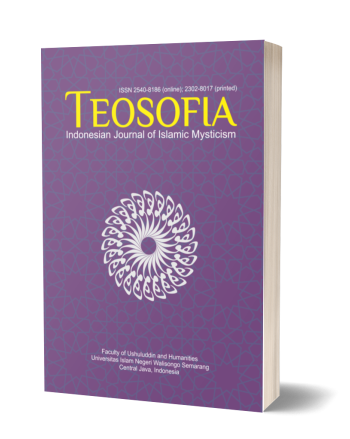


About the Journal

Journal Title Teosofia: Indonesian Journal of Islamic Mysticism
Abbreviation Teosof. Indones. J. Islam. Mysticism
Short Title Teosofia
Language English (preferred); Arabic
ISSN 2540-8186 (online); 2302-8017 (printed)
Editor in Chief Prof. Dr. Hasyim Muhammad, M.Ag. (Scopus; Orcid; Google Scholar)
Co-Editor in Chief Muhammad Faiq, M.A. (Scopus; Orcid; Google Scholar)
Publisher Faculty of Ushuluddin and Humanities, Universitas Islam Negeri Walisongo Semarang, Campus 2, St. Prof. Dr. HAMKA, Km.1, Tambakaji, Ngaliyan, Semarang, Central Java, Indonesia 50185
Publication Frequency 2 issues per year (June and December)
DOI Prefix (Crossref) 10.21580/tos
National Accreditation SINTA 2 (Science and Technology Index)
Subject Areas Arts and Humanities (History and Philosophy of Science, Religious Studies)
Discipline Categories 1) Sufi Orders (Tariqas), 2) Living Sufism, 3) Eco-Sufism, d) Sufi Thoughts and Doctrines, 4) Histories and Area Studies of Sufism, 5) Sufi Manuscripts, 6) Sufism and Arts, 7) Sufi Healings, 8) Local Sufism, 9) Interdisciplinary Study of Sufism
Citation Analysis SCOPUS (82 citedness from 50 docs); SINTA; GARUDA; Google Scholar; Index Copernicus; Dimensions

Teosofia: Indonesian Journal of Islamic Mysticism is a peer-reviewed international journal published twice a year by the Faculty of Usuluddin and Humanities, Universitas Islam Negeri Walisongo, Semarang, Indonesia. All submitted manuscripts are subject to a thorough double-blind peer review to maintain academic integrity and scholarly standards. The journal serves as a scholarly platform for in-depth discussions of Islamic mysticism from diverse perspectives. Therefore, TEOSOFIA aims to promote original research articles based on textual and primarily empirical studies encompassing philosophical (falsafi), theoretical (akhlaqi), and practical (amali) Sufism; to encourage the integration of Islamic spiritual tradition with other fields of study, such as education, health, ecology, psychology, economics, social, and politics; to bridge a global exchange of ideas among scholars from Western and Eastern perspectives; and to foster Sufism studies to examine its significance and relevance to address contemporary issues of modern society.

The journal features contributions from scholars affiliated with institutions across Egypt, Malaysia, Nigeria, the United States, Morocco, Yemen, Iran, Thailand, the United Kingdom, Tunisia, Türkiye, India, the United Arab Emirates, China, the Netherlands, and Germany. This showcases a growing diversity of international authorship from Africa, Asia, Europe, and America. Through this global academic network, Teosofia fosters idea exchange and promotes the growth of international scholarship in Sufism.

Although its name suggests that its scope is limited to studying Islamic mysticism in Indonesia, this is not the case. Teosofia: Indonesian Journal of Islamic Mysticism covers all subject areas, with its management based in Indonesia. The journal was first published in print in 2012 and has been accessible online since 2015. Since 2016, the journal has been a member of Crossref, which ensures that every published article receives a persistent and unique Digital Object Identifier (DOI). This enhances citation tracking and scholarly integration. Nationally, TEOSOFIA has shown consistent academic excellence, first earning a “B” accreditation from 2016 to 2020, then being ranked as SINTA 2 from 2020 to 2024, and re-accredited as SINTA 2 (Science and Technology Index) by the Ministry of Education, Research, and Technology of the Republic of Indonesia, based on Decree No. 295/C/C3/KPT/2026, dated 2 January 2026, valid until Volume 18, No. 1 (2029). TEOSOFIA has also been indexed by DOAJ (Directory of Open Access Journals) in 2023. In 2024, the official publisher URL for TEOSOFIA was updated to https://journal.walisongo.ac.id/index.php/teosofia/index


This journal has been indexed by:


Current Issue

Vol. 15 No. 1 (2026)

Author Geographical Coverage: Indonesia, Türkiye

Published: 2026-06-01

Articles

  • Sufism, Local Wisdom, and Institutional Identity: A Semiotic Interpretation of the UIN Saizu's Emblem

    Suwito Suwito, Universitas Islam Negeri Profesor Kiai Haji Saifuddin Zuhri Purwokerto, Indonesia
    Abdulcebbar Kavak, Karabuk University, Turkey
    Ida Novianti, Universitas Islam Negeri Profesor Kiai Haji Saifuddin Zuhri Purwokerto, Indonesia
    Zein Muchamad Masykur, Universitas Islam Negeri Profesor Kiai Haji Saifuddin Zuhri Purwokerto, Indonesia
    1-28
    DOI: https://doi.org/10.21580/tos.v15i1.29122
    Abstract View: 88 PDF Download: 71
View All Issues