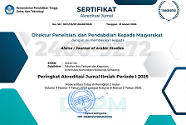
 Accreditation

Alsina : Journal of Arabic Studies uses the American Psychological Association 7th Edition (APA 7th) style for all citations and references. This style applies to all manuscripts submitted from Volume 8, Number 2 (2026) onward. Articles published in earlier volumes follow the Chicago Manual of Style (full note), 17th Edition, and are not required to be converted.
Authors are responsible for the accuracy and completeness of every citation and reference, including sources written in Arabic.
APA 7th uses the author–date system. Citations appear in the body of the text in parentheses, not in footnotes. Footnotes may be used only for essential explanatory notes.
All works cited in the text must appear in the reference list, and every entry in the reference list must be cited in the text.
Journal article
Hasanah, U. (2023). Improving Arabic speaking skills through project-based learning. Alsina : Journal of Arabic Studies, 6(1), 45–62. https://doi.org/10.21580/alsina.6.1.12345
Journal article with three or more authors
Wahyudi, A., Fauzi, M., & Rahman, S. (2024). Balaghah instruction and students' critical reading of the Qur'an. ALSUNIYAT: Jurnal Penelitian Bahasa, Sastra, dan Budaya Arab, 7(2), 101–118. https://doi.org/10.17509/alsuniyat.v7i2.45678
Book
Al-Ghalayini, M. (2010). Jami’ al-durus al-‘arabiyyah [Comprehensive Arabic lessons]. Dar al-Kutub al-‘Ilmiyyah.
Chapter in an edited book
Hasanah, U. (2022). Nahwu instruction in Indonesian pesantren. In A. Wahyudi (Ed.), Arabic language education in Southeast Asia (pp. 88–107). Routledge.
Translated or classical Arabic work
Al-Jurjani, A. Q. (2004). Asrar al-balaghah [The secrets of eloquence] (M. A. Khan, Trans.). Dar al-Ma‘rifah. (Original work published 1081)
Thesis or dissertation
Fauzi, M. (2021). Pengembangan media pembelajaran bahasa Arab berbasis Android [Development of Android-based Arabic learning media] [Master’s thesis, Universitas Islam Negeri Walisongo Semarang]. Repository UIN Walisongo. https://eprints.walisongo.ac.id/xxxxx
Conference paper
Rahman, S. (2023, November 15–16). Balaghah teaching in the digital era [Paper presentation]. International Conference on Arabic Studies, Semarang, Indonesia.
Web page
Naifah. (2024, March 10). Arabic proficiency standards for Indonesian madrasas. Alsina : Journal of Arabic Studies. https://journal.walisongo.ac.id/index.php/alsina/about
Give the title in its original Arabic script or in a consistent transliteration, followed by an English translation in square brackets. Do not italicise the bracketed translation.
Al-Sakkaki, Y. (1987). Miftah al-‘ulum [The key of sciences] (N. Al-Hindi, Ed.). Dar al-Kutub al-‘Ilmiyyah.
For Arabic terms written in Latin script, authors must follow the transliteration system issued by the Library of Congress (LOC), available at https://www.loc.gov/catdir/cpso/romanization/arabic.pdf. Apply the chosen system consistently throughout the manuscript.
Authors must use a reference manager, with Mendeley strongly preferred; Zotero is also accepted. Set the citation style to American Psychological Association 7th edition so that in-text citations and the reference list are generated consistently. Authors remain responsible for checking the output, since imported metadata are often incomplete or incorrectly capitalised.
From Volume 8, Issue 1 (2026), manuscripts must be written in English, formatted in Cambria 12 pt with 1.15 line spacing in Microsoft Word, B4 page size, and 5000 to 7000 words. Full requirements are set out in the Author Guidelines, and the manuscript must follow the Article Template.
Accreditation
 Governing Body & Contact
 Journal Policies
 Submissions
 In Collaboration with

 Article Template

 User


 Citation Statistics

Alsina : Journal of Arabic Studies
Arabic Language Education Department, FTIK
UIN Walisongo, Semarang, Indonesia
Jl. Prof. Dr. Hamka, Tambakaji, Kec. Ngaliyan, Kota Semarang, 50185
Central Java, Indonesia
Email: [email protected]
ISSN: 2622-6138 (Print)
ISSN: 2622-6146 (Online)

This work is licensed under a Creative Commons Attribution-NonCommercial-ShareAlike 4.0 International License.

 Visitors