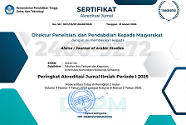
 Accreditation

Alsina : Journal of Arabic Studies publishes scholarly manuscripts that advance knowledge in the teaching and learning of Arabic as a first, second, or foreign language. The journal mainly accepts original research articles using quantitative, qualitative, or mixed-methods approaches. Each manuscript must show scientific rigour, a research design that fits its questions, and a clear contribution to Arabic language learning theory, research, or classroom practice. Manuscripts should fall within the journal's focus and scope: Arabic language acquisition; language teaching strategies; translation studies; linguistics; literature; and the influence of gender and identity in Arabic language education.
The journal considers the following types of manuscripts:
1. Quantitative Research Articles
Original empirical studies that use quantitative methods to investigate Arabic language learning and teaching, test hypotheses, develop or validate language assessment instruments, and examine relationships, differences, or effects among variables such as proficiency, learner motivation, anxiety, strategy use, or instructional interventions. Suitable designs include experimental, quasi-experimental, correlational, survey, corpus-based quantitative analysis, test development and validation, and other appropriate quantitative approaches.
2. Qualitative Research Articles
Original empirical studies that explore learners' and teachers' experiences, perceptions, beliefs, identities, classroom interaction, and language use in social and educational settings through qualitative approaches. Suitable methodologies include case study, phenomenology, ethnography, narrative inquiry, classroom action research, discourse and conversation analysis, document or textbook analysis, and other rigorous qualitative designs.
3. Mixed-Methods Research Articles
Original empirical studies that combine quantitative and qualitative approaches within one coherent research design. Authors should explain why both methods are needed, show how the findings from each strand are integrated, and make clear what the mixed-methods approach adds to the understanding of Arabic language learning or teaching.
4. Interdisciplinary, Multidisciplinary, and Transdisciplinary Research Articles
Empirical studies that bring Arabic language education into dialogue with other fields, such as linguistics (including nahwu, sharaf, and balaghah), literature, translation studies, psychology, sociology, technology (including AI in language learning), and Islamic or multicultural education, to address complex problems in Arabic language learning. These manuscripts must still make a clear contribution to Arabic language teaching and learning and explain why the cross-disciplinary approach is relevant.
Manuscripts outside the journal's focus and scope, or those that do not follow the Author Guidelines and the Article Template, will be rejected without review.
Accreditation
 Governing Body & Contact
 Journal Policies
 Submissions
 In Collaboration with


 Article Template

 User


 Citation Statistics

Alsina : Journal of Arabic Studies
Arabic Language Education Department, FTIK
UIN Walisongo, Semarang, Indonesia
Jl. Prof. Dr. Hamka, Tambakaji, Kec. Ngaliyan, Kota Semarang, 50185
Central Java, Indonesia
Email: [email protected]
ISSN: 2622-6138 (Print)
ISSN: 2622-6146 (Online)

This work is licensed under a Creative Commons Attribution-NonCommercial-ShareAlike 4.0 International License.

 Visitors