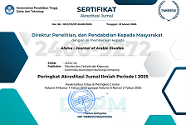
 Accreditation

This journal issue demonstrates strong international collaboration, with Indonesia serving as the academic hub connecting institutions across Asia, the Middle East, and Africa. The network now extends to Sudan, Malaysia, Japan, Pakistan, Türkiye, Libya, Saudi Arabia, Egypt, and Jordan, bringing together diverse perspectives on Arabic language education, curriculum innovation, educational technology, language assessment, translation, and classroom practice.
This issue highlights the growing international outlook of Arabic language studies by bringing together contributions from scholars in Indonesia and Malaysia. While Indonesian universities represent the core of the authorship, collaboration with the International Islamic University Malaysia broadens the regional dimension of the issue. Collectively, the articles advance contemporary discussions on Arabic language pedagogy, artificial intelligence, textbook evaluation, sociopragmatics, and language management, reflecting the dynamic evolution of Arabic education and linguistic research.
This issue showcases an expanding international research network, linking Indonesian scholars with collaborators from Saudi Arabia, Sudan, Gambia, Uzbekistan, and Nigeria. The diverse institutional affiliations enrich the exchange of academic perspectives while reflecting the interdisciplinary nature of Arabic language studies. Covering themes from language assessment, gamified learning, translation studies, phonology, multicultural education, and curriculum integration, the issue demonstrates the journal’s commitment to advancing globally relevant scholarship in Arabic language education and linguistics.
This issue underscores the journal’s growing regional and international engagement through collaborations between Indonesian institutions and partners in Malaysia and Sudan. The articles offer complementary perspectives on Arabic language education, addressing native-speaker instruction, teaching methodologies, instructional media, traditional learning approaches, and technology-assisted listening. Together, they reflect ongoing efforts to integrate pedagogical innovation with established practices in Arabic language teaching.
This issue reflects the journal’s commitment to fostering international academic exchange through collaborations between Indonesian scholars and partners from Malaysia, Egypt, and Thailand. The contributions explore a wide range of topics, including instructional media, language learning strategies, Arabic linguistics, digital assessment, vocabulary instruction, and online language learning, highlighting both pedagogical innovation and linguistic inquiry in contemporary Arabic studies.
This issue demonstrates the journal’s expanding international engagement through scholarly collaborations involving Indonesia, Singapore, Malaysia, and Egypt. The published studies examine diverse aspects of Arabic language education and linguistics, ranging from learning effectiveness, curriculum and textbook evaluation, digital assessment, children's language learning, and semantic analysis to the philosophical foundations of Arabic language instruction, reflecting the journal’s commitment to advancing innovative and globally informed scholarship.
This issue brings together contributions from scholars across Indonesian higher education institutions, reflecting the diversity of contemporary Arabic language scholarship. The articles span innovative teaching approaches, digital learning media, Arabic grammar instruction, semantics, discourse analysis, and social media studies, demonstrating the journal’s commitment to strengthening both theoretical and pedagogical developments in Arabic language education and linguistics.
This issue presents a broad spectrum of research from Indonesian scholars, highlighting current developments in Arabic language education and linguistics. The articles address inclusive education, instructional material development, post-pandemic learning challenges, Arabic phonology, reading comprehension, and speaking instruction, reflecting the journal’s dedication to promoting evidence-based practices and linguistic inquiry in diverse educational contexts.
This issue features contributions from scholars in Indonesia and Egypt, reflecting the journal’s early commitment to international academic collaboration. The articles explore key issues in Arabic language education, including reading instruction, grammar learning, translation accuracy, instructional materials, and language enrichment activities, offering practical and scholarly insights into the advancement of Arabic teaching and learning.
This issue brings together contributions from Indonesia and Saudi Arabia, illustrating the journal’s expanding international reach. The published studies examine Arabic linguistics, language teaching strategies, vocabulary and grammar acquisition, educational technology, digital learning resources, and instructional innovation, highlighting the journal’s role in advancing both linguistic research and effective Arabic language pedagogy.
This issue highlights scholarly contributions from Indonesian researchers addressing a wide range of topics in Arabic language education and linguistics. The articles examine dictionary use, speaking instruction, pandemic-responsive teaching materials, Arabic grammar, textbook evaluation, and communicative language teaching, reflecting the journal’s commitment to supporting innovative, context-sensitive, and practice-oriented research in Arabic studies.
This issue presents diverse contributions from Indonesian scholars, highlighting both theoretical and practical dimensions of Arabic language studies. The articles explore instructional media, teacher competence, modern linguistic theory, extracurricular language programs, semantic analysis, and game-based learning, reflecting the journal’s commitment to advancing research that supports effective Arabic language teaching and linguistic scholarship.
This issue showcases research from Indonesian scholars addressing diverse dimensions of Arabic language education and literary studies. The articles discuss cooperative learning, challenges in Arabic education in Thailand, language immersion programs, classical Arabic poetry, social media–supported learning during the pandemic, and debate-based speaking instruction, reflecting the journal’s commitment to bridging educational innovation with linguistic and cultural scholarship.
This issue features contributions from Indonesian scholars that reflect the journal’s early emphasis on strengthening Arabic language education through innovative and context-responsive research. The articles explore Qur’anic semantics, curriculum design, interactive multimedia, quality management in language education, locally grounded teaching materials, and humanistic assessment, demonstrating a balanced integration of linguistic inquiry and pedagogical development.
As the inaugural issue, this volume lays the foundation for the journal’s scholarly focus on Arabic language education and linguistics. Featuring contributions from Indonesian academics, the articles address Arabic morphology, learner motivation, reading difficulties, classical text reading strategies, reading instruction, and speaking pedagogy, establishing the journal’s commitment to rigorous, practice-oriented, and theoretically informed research in Arabic studies.
Accreditation
 Governing Body & Contact
 Journal Policies
 Submissions
 In Collaboration with


 Article Template

 User
User


 Citation Statistics

Alsina: Journal of Arabic Studies
Arabic Language Education Department, FITK
UIN Walisongo, Semarang, Indonesia
Jl. Prof. Dr. Hamka, Tambakaji, Kec. Ngaliyan, Kota Semarang, 50185
Central Java, Indonesia
Email: [email protected]
ISSN: 2622-6138 (Print)
ISSN: 2622-6146 (Online)

This work is licensed under a Creative Commons Attribution-NonCommercial-ShareAlike 4.0 International License.

 Visitors