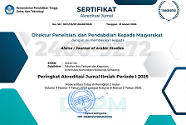
 Accreditation

This policy sets out how members of the International Advisory Editorial Board of Alsina : Journal of Arabic Studies are appointed, how long they serve, what is expected of them, and how the journal communicates with them. It applies to every member of the board, from the time of appointment onward.
The International Advisory Editorial Board is an advisory body. Its members support the journal with their academic standing, their expertise, and their international perspective. They do not handle manuscripts and take no part in editorial decisions on individual submissions. What each member of the editorial team is responsible for is described on the Editorial Member Role page.
Members are appointed by invitation of the Editor-in-Chief, after consultation with the editorial team. In composing the board, the journal seeks a distribution of expertise that covers its focus and scope, and a geographical spread that reflects its authors and readers. Invitations are issued in writing and state the role, the term of service, and the commitments involved. Membership involves no fee of any kind.
The initial term of membership is three years. The appointment may be renewed for further terms by mutual agreement between the member and the journal. The term of the advisory board is independent of the terms of the editors and of the Editor-in-Chief.
Members serve in an advisory capacity. Their contribution is occasional and strategic, and consists of advising the journal on its development, recommending potential authors, reviewers, and opportunities for academic collaboration, and promoting the journal within their academic networks. Membership carries no routine editorial duties, no obligation to submit articles, and no obligation to review manuscripts; any review invitation is sent separately and depends entirely on the availability and willingness of the member. The full description of the role is given on the Editorial Member Role page.
The journal communicates with the board mainly by email, through three mechanisms.
Annual Editorial Update — once a year. An email report on the development of the journal and its academic achievements, covering the number of articles published, the countries of origin of authors, international collaboration, developments in indexing, and the agenda of the journal for the coming year.
Advisory Consultation — as needed. A request for the views of individual members in their areas of expertise, for example on the development of the scope of the journal, on the quality of published articles, or on a strategy for internationalisation.
Special Invitation — when a specific agenda arises. An invitation to comment on the theme of a special issue, to suggest reviewers, or to recommend potential authors.
No annual meeting is held. Communication is kept light on purpose, so that members can remain engaged throughout the term of their appointment.
A member may resign at any time by notifying the Editor-in-Chief. The journal reviews the composition of the board periodically and may make changes when the coverage of its scope or its geographical balance requires it. Any renewal, change, or end of appointment is communicated to the member concerned.
Questions about this policy may be addressed to the Editor-in-Chief through the contact page.
Accreditation
 Governing Body & Contact
 Journal Policies
 Submissions
 In Collaboration with

 Article Template

 User


 Citation Statistics

Alsina : Journal of Arabic Studies
Arabic Language Education Department, FTIK
UIN Walisongo, Semarang, Indonesia
Jl. Prof. Dr. Hamka, Tambakaji, Kec. Ngaliyan, Kota Semarang, 50185
Central Java, Indonesia
Email: [email protected]
ISSN: 2622-6138 (Print)
ISSN: 2622-6146 (Online)

This work is licensed under a Creative Commons Attribution-NonCommercial-ShareAlike 4.0 International License.

 Visitors