 Accreditation
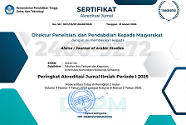

This journal issue demonstrates strong international collaboration, with Indonesia serving as the academic hub connecting institutions across Central Asia, South Asia, Southeast Asia, and the Middle East. The network extends to Uzbekistan, India, Malaysia, Brunei Darussalam, Yemen, Egypt, and Türkiye, bringing together diverse perspectives on Arabic language education, linguistics, educational technology, AI-assisted learning, curriculum design, balāghah, and cross-faith rhetorical analysis.
Accreditation
 Governing Body & Contact
 Journal Policies
 Submissions
 In Collaboration with

 Article Template

 User


 Citation Statistics

Alsina : Journal of Arabic Studies
Arabic Language Education Department, FTIK
UIN Walisongo, Semarang, Indonesia
Jl. Prof. Dr. Hamka, Tambakaji, Kec. Ngaliyan, Kota Semarang, 50185
Central Java, Indonesia
Email: [email protected]
ISSN: 2622-6138 (Print)
ISSN: 2622-6146 (Online)

This work is licensed under a Creative Commons Attribution-NonCommercial-ShareAlike 4.0 International License.

 Visitors